
By Marla Crawford, General Counsel, Cimplifi.
There has never been a more exciting time to work in legal technology. There has also never been an easier time to create a mess.
New AI tools are entering the market at an extraordinary pace. They can summarize documents, identify patterns, answer questions, generate search terms, analyze communications, and help legal teams understand information faster.
That is real progress.
But there is a danger hiding inside that progress: the more tools we add, the easier it becomes for data, insights and work product to become scattered across disconnected systems.
In litigation, investigations, and eDiscovery, that is more than inconvenient. It can create real risk.
I have spent my career working in complex discovery, from overseeing discovery in significant litigation to building and leading a global eDiscovery practice at a major financial institution. What that experience has taught me is simple: technology is only as effective as the workflow surrounding it.
The Risk Isn’t AI. It’s Fragmentation.
Legal teams want access to the latest technology. But fragmentation can happen quickly. One AI tool solves one problem, another handles a different task, and soon pieces of the same matter are moving through multiple applications, repositories, and environments.
The danger is what happens when the data, insights, and work product no longer stay connected to the legal workflow.
We hear this concern from clients. They want the advantages of AI while still knowing where their data is, who has access to it, and whether today’s initial work will carry into their formal review process. For many legal teams, Relativity aiR is where that work ultimately needs to come together as the system of record. There is risk in allowing the data, decisions, and insights created earlier in the process to become disconnected from the auditable, defensible workflow that is ultimately necessary in most regulatory and litigation matters.
The technology may be getting smarter while the overall workflow becomes harder to govern.
Why Disparate Data Gets You in Trouble
When data and work product are scattered across disconnected systems, risks are created, such as:
Defensibility.
Discovery is a process you may ultimately have to explain to opposing counsel, a regulator, or a court. Where did a document come from? Who had access? What happened to it? What information led to a conclusion?
If important early work occurred outside the governed discovery workflow, answering those questions becomes much harder. Defensibility isn’t something you add at the end. It has to be built into the workflow.
Control.
Legal data typically includes privileged communications, personal information, and highly sensitive client or business information. When copies of that data begin moving among disconnected tools and locations, maintaining consistent access controls, permissions, retention policies, and auditability becomes increasingly difficult.
We need to think about AI not only in terms of what it can tell us, but also in terms of what happens to the information we give it.
Cost.
This may be the consequence clients feel most directly. Your team has analyzed documents, asked questions, identified important information, and made decisions. Once the matter progresses, that work produce may not be able to move with the data.
The same documents are revisited, the same questions asked, and prior decisions are rethought.
You haven’t just created an efficiency problem. You’ve paid for work that should have carried forward.
The Next Challenge for Legal AI
For years, the legal technology conversation has focused on capabilities: What can the application do? How quickly can it do it? How much can it automate?
The next phase needs to focus just as much on continuity. Can early insight remain connected to the data that produced it? Can that intelligence follow the matter as it evolves?
Why We Developed Maestro
We recognized this fragmentation problem in the market and hear these concerns from our clients. Users want the advantages of AI without creating more technology silos or abandoning work already done.
That is why Cimplifi developed Maestro.
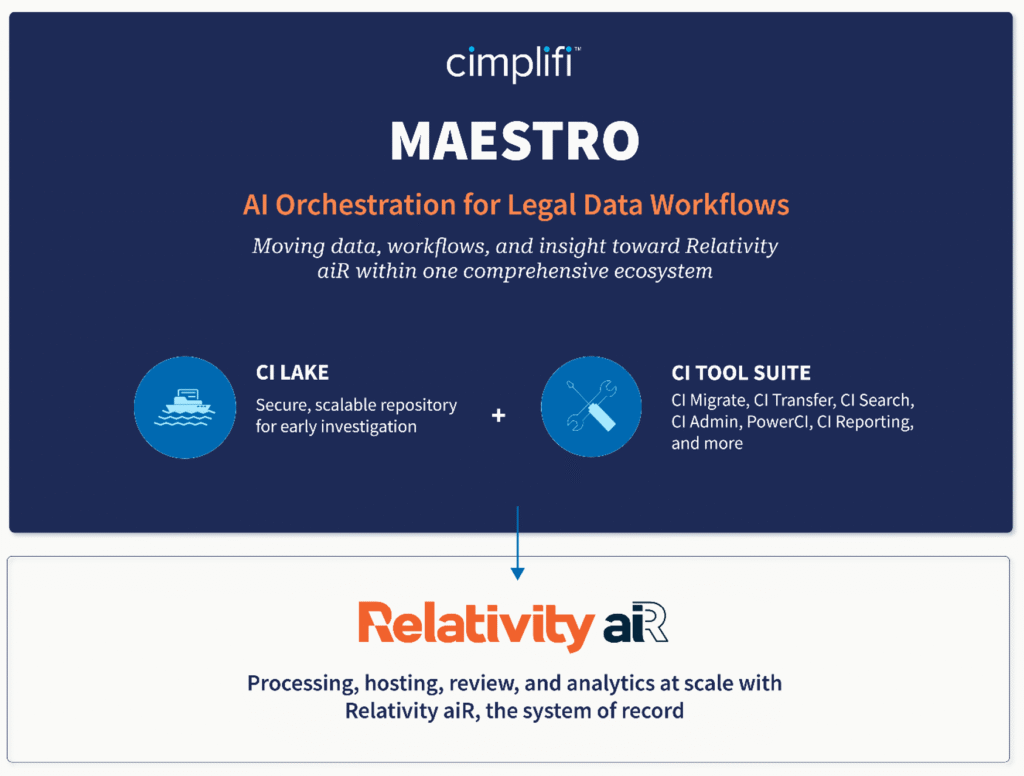
Maestro is a centralized AI orchestration platform that coordinates tools, data, and workflows across the Cimplifi ecosystem. Users describe the outcome they need in natural language, and Maestro orchestrates the appropriate processes.
Working with CI Lake, Maestro helps teams understand matter data earlier while maintaining a path to downstream legal workflows. When deeper review or production is needed, it helps transition the work into Relativity aiR with context and reusable work product preserved.
AI Still Needs Legal Judgment
Legal workflows are not generic or simple. Privilege, proportionality, security, and defensibility matter greatly. Sometimes the right answer isn’t more automation. It’s experienced legal judgment.
Technology should make expertise more effective and serve as an enablement tool for legal professionals.
The most consequential discovery decisions still require the judgment of legal professionals who need to understand the context, the source, and the strategy.
A Different Question for Legal Teams
As AI adoption accelerates, legal teams need to ask more than, “What can this tool do?” They also need to ask, “What happens to my data and my work product after I use it?”
Can the insight be carried forward? Can the team understand its source? Can the work move into the system of record without starting over?
Those may not be the most exciting questions in AI today. But for legal professionals responsible for what happens when technology meets a real case, they may be the most important.
The future of legal AI won’t be defined by how many tools an organization can accumulate. It will be defined by how intelligently the tools, data, expertise, and workflows work together.
Because the biggest risk may not be choosing the wrong AI tool. It may be losing control of everything happening between them, where visibility, control, and accountability can break down.
You can learn more about Cimplifi’s Maestro here.
–
About the Author: Marla Crawford is an attorney, strategic advisor, and thought leader with more than 35 years of experience spanning private practice and in-house leadership. She speaks regularly on legal technology, eDiscovery, and legal operations.
—
[ This is a sponsored thought leadership article by Cimplifi for Artificial Lawyer. ]
Discover more from Artificial Lawyer
Subscribe to get the latest posts sent to your email.