
By Darsan Guruvayurappan, Co-founder, Lucio AI.
Most legal research does not end when the answer is found, it ends when the time runs out.
Let me explain. Nobody writes ‘I stopped at the fourteenth judgment because it was 9pm and the fee was fixed.’ But, unfortunately that is how most legal research ends now. It ends when the cost of looking further outweighs the likely value of what might turn up, not when every relevant authority has been found. Research has always been rationed by time, by budget and by what a client will accept on a bill.
Our profession has made its peace with this. The ABA’s Model Rule 1.1 asks for the ‘thoroughness and preparation reasonably necessary for the representation’ and ‘reasonably’ has always been measured against what was feasible. A competent associate is expected to find the leading authorities, follow the obvious lines and know when the next search stops paying.
Well, most of the debate about AI in legal research asks two questions: are the answers right and how quickly do they arrive and both matter. But the more consequential shift is way quieter. And AI is changing where the stopping point sits. When reading three hundred authorities takes about as long as reading twenty, the economics of thoroughness change. In time, so will expectations of what reasonable research looks like.
Take a familiar English law question: whether a clause excluding liability for ‘consequential loss’ catches a particular head of loss under a supply contract. The starting point is well known, running back to Hadley vs Baxendale. But the useful authority is often not the leading case, it is the first instance decision where a court construed similar wording in a similar commercial setting. That decision may sit thirty or forty results down a search, behind cases that use the right words to decide something else.
This is the characteristic failure of time-rationed research and it is not usually that the lawyer gets the law wrong. It is that they sometimes miss the closest case. And omission is partly invisible. Nobody sees the judgment that was never opened, until the other side cites it.
The first wave of general-purpose AI tools made research faster without obviously making it broader. A chatbot can produce a fluent answer in seconds, but an answer drawn from a handful of sources compresses the time while keeping the ration. A memo built on six cases looks thin while a confident paragraph built on six cases does not.
Breadth is not free for machines either. Many AI research agents work in a loop: decide what to look at, read it, decide again. That design is flexible, but it is sequential, so each additional source adds time. The builders face the same trade-off as the associate at 9pm, on a shorter clock.
The courts have so far dealt with the louder version of the problem. In Mata vs Avianca in 2023, a New York federal court sanctioned lawyers for citing cases ChatGPT had invented. In Ayinde vs Haringey last year, the Divisional Court in London issued a sharp warning about fictitious citations. Fabricated authority is the visible failure. The quieter one is the answer that is real but thin: every citation exists, and the closest case is still missing.
So the useful question to ask of an AI research tool is not ‘how fast?’ on its own. It is how much it read, how it decided what mattered and whether a lawyer can trace each proposition back to a passage they can open. Speed only means something as a ratio.
If breadth does become cheap, the opportunity is significant. Research stops being the line item most likely to be written off. The junior lawyer’s job shifts from finding authority to testing it: checking whether the reasoning transfers to the facts and spotting where it does not. Questions that were never worth researching on a fixed fee become worth asking.
And the limitations are just as real. Reading more is not judging better and a system that reads three hundred judgments and summarises them poorly is worse than a lawyer who reads fifteen well. Verification does not scale the way search does. Nobody will re-read three hundred authorities, so trust moves to how the system screened them and that screening has to be visible. Coverage also depends on what a tool can reach. And if exhaustive research becomes cheap, the standard of reasonable research may drift upwards for everyone.
One response is to build research systems around the legal research workflow itself, rather than adapting a general-purpose chatbot to it. At Lucio, that is what we are testing with Lucio Research, an open experiment from Lucio Labs. It replaces a pure agent loop with fast decision models on an architecture built for parallel work. The aim is to make breadth cheap rather than answers quick: it searches, screens and reads across hundreds of legal sources, and in its in-depth mode checks for gaps before it answers. It is optimised for case law in the US, UK and India, and regulation and legislation remain work in progress. It is free and open to anyone for a month, because the point of the experiment is to find its limits on real questions.
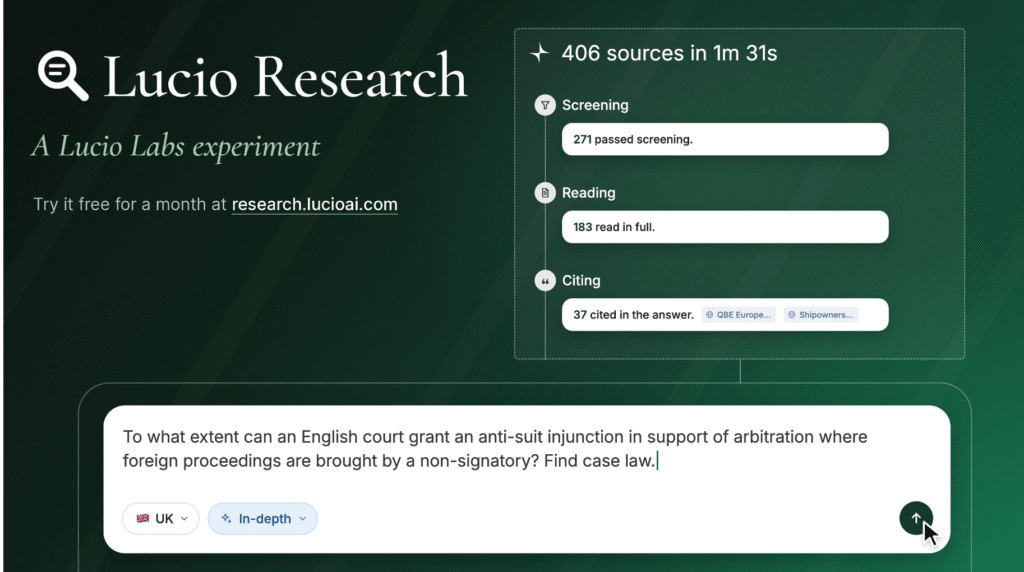
The detail that matters here is not the time. Discarded sources are listed alongside cited ones, so a lawyer can see what was set aside as well as what was relied on. Source counts prove nothing on their own. The test is whether the work can be followed and checked, for our tool as for anyone’s.
None of this changes who is responsible like the lawyer still signs the memo. What changes is the force of a familiar explanation: ‘we did not have time to find it’ has always been a reasonable answer to a missed case. And it may not stay one for long. The more interesting question is not how fast research can be done but what lawyers, clients and courts will expect once thoroughness becomes affordable.
To learn more about Lucio Research, please see here.
—
[ This is a sponsored thought leadership article by Lucio for Artificial Lawyer. ]
Discover more from Artificial Lawyer
Subscribe to get the latest posts sent to your email.