
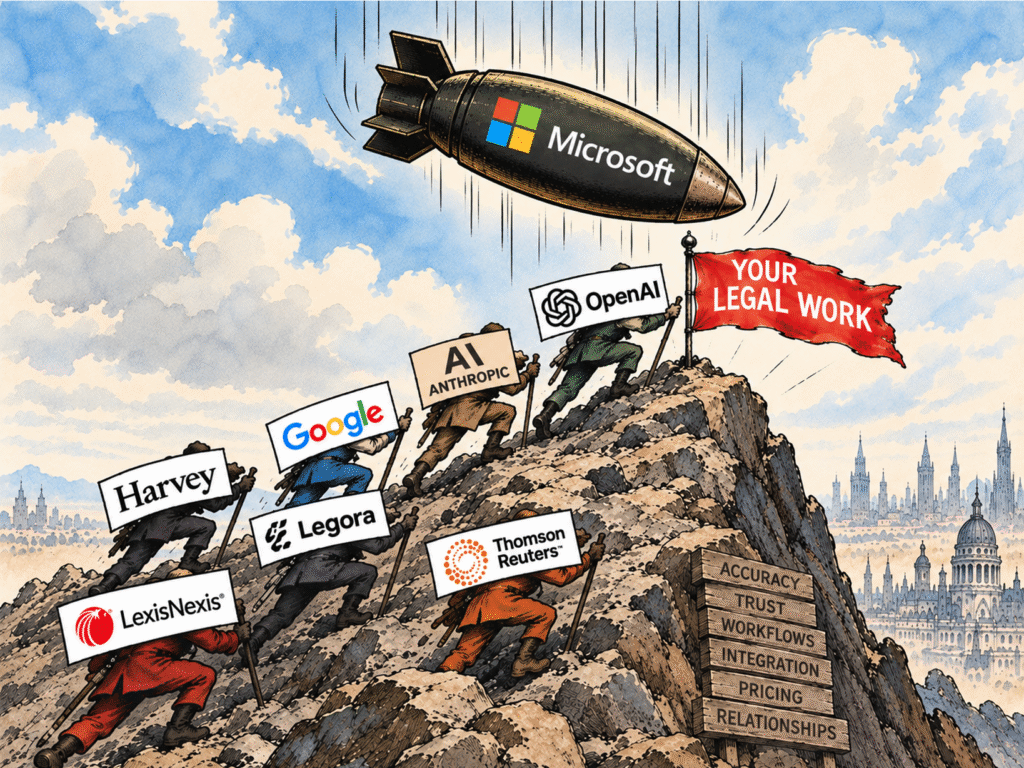
Microsoft – the software company the world’s lawyers rely upon because of Word – has gone nuclear and launched Copilot for Legal, its own multi-capability AI venture into our vertical. It could cause some anxiety for those companies with overlapping skills, even if many – including Harvey and Legora – have agreed to be plugins.
Microsoft has used a similar blueprint to the AI giants, such as OpenAI, Google and Anthropic – with a mix of 20+ skills and connectors to a wide range of legal tech partners. (See following AL piece for additional analysis.)
In April, Microsoft announced their Legal Agent, a relatively narrow tool that came after the Robin AI tech team joined them – see here. However, what they’re launching now is far broader and as mentioned, in many ways now follows what we can call the ‘Legal Vertical Blueprint’ that companies such as Anthropic pioneered via Claude for Legal.
So, what is the offering? It will work via Word and also Cowork – its more agentic capability. And as you can see below, it covers off a very wide range of legal AI skills – which many legal tech companies now provide either as point solutions, or as part of their platform. In short: watch out for overlaps!!!
Microsoft explained that Copilot for Legal in Word will ‘support in-depth document analysis, drafting and revision, while Cowork helps legal professionals carry out broader, multi-step workflows across files and applications’. I.e. the first is more prompt-centric, the other path is more agentic.
‘In Word, legal professionals can review agreements against playbooks, draft from approved templates and precedents, and apply proposed revisions as tracked changes.
‘[And] in Cowork, they can coordinate work across collections of contracts and Microsoft 365 applications, including extracting obligations and deadlines, comparing agreements and building case chronologies.’
They then broke this down and noted that the 20+ purpose-built legal skills will cover to start with:
- ‘Draft and standardize legal documents: Create agreements, memos and playbooks using business requirements, approved templates and precedents.
- Review and negotiate contracts: Review agreements against organizational playbooks, flag provisions requiring attention, explain redlines and apply proposed edits as tracked changes in Word.
- Manage contracts and obligations: Compare terms across agreements, trace related contracts, and extract obligations and deadlines into a structured tracker with links to the source material.
- Research, analyze and advise: Compare requirements, identify potential gaps, explain complex legal issues and organize findings into clear guidance.
- Manage matters and governance: Build case chronologies, surface key developments and open questions, and turn meeting records into minutes and resolutions.’
And in terms of the plugin partners – which seem to be joining in much the same way as they have for Google, OpenAI and Anthropic – there are many of the same companies we have seen before do such deals.
Although, AL cannot see a mention of LexisNexis or Thomson Reuters directly sharing their legal data with Copilot for Legal – above and beyond how they might do so already with Microsoft.
— Legal Innovators New York Conference – Nov 17 + 18 —
—
Here are the plugin partners – some of which will hope to benefit from such a relationship with the massively ‘centralized’ Microsoft; and with others grudgingly agreeing to be part of this launch, but in private absolutely dreading what it may do to their businesses. AL will explore this more in the following analysis.
Here’s the list that Microsoft shared with Artificial Lawyer.
- Legal research: Bloomberg Law, Trellis, Descrybe Legal Engine, Legal Data Hunter, Courtroom5 and Lawstronaut – (but, as noted, not TR or Lexis in the data-sharing part, or at least not in this list.)
- Document, matter and transaction management: iManage Work, NetDocuments, Box, Litera, HighQ from Thomson Reuters, LegalZoom and Solve Intelligence
- Agreements and electronic signature: Docusign, Juro, Adobe Acrobat Sign, LawVu, SignatureAPI, Dropbox Sign and PandaDoc
- Legal AI and e-discovery: Harvey, Legora, Relativity and Everlaw Microsoft
As you can see, some of the above companies, such as iManage will have no problem at all working closely with Copilot for Legal, as they want to feed the documents they hold into the workstream – wherever it may be.
Other companies will have a much more complicated thought process here. They don’t want to be ‘left out’, or act as a competitor to Microsoft, as that’s not really possible. But, if you’re building a platform where you want ‘centrality’ – then Microsoft and its Word ‘gravity well’, plus all the skills – with perhaps more to come – cannot be anything less than competition, especially for some of the more contract-focused companies.
In short, if these skills turn out to be good and lawyers are happy to use them, then this is massive. If the skills turn out to be ‘meh’, and lawyers don’t like them, then a large chunk of the legal tech world will breathe a sigh of relief.
Artificial Lawyer asked Harvey’s CEO, Winston Weinberg what he thought, and he told this site: ‘We are proud to have MSFT as a customer and a partner at Harvey and to be a part of today’s launch.’
The overall vibe, at Harvey at least, is therefore – to paraphrase: we are not getting worried about this. Will that be the same for everyone?
One could argue that as the overall legal AI market is so large now, and growing, and that as the major legal AI platforms are putting so much into making those platforms essential to lawyers’ daily work – then even if Copilot for Legal is good, it won’t hurt some of the bigger players.
Equally, if it does take off, then AL can see plenty of lawyers at a range of law firms and inhouse teams feeling ‘this is enough for now’ – if their demands for AI are limited.
Last word to Aneesh Mehta, Senior Corporate Counsel, Microsoft: ‘For me, the real benefit of Copilot is that I don’t have to change how I work. I’m already living in Word when I negotiate an agreement, and now I can use Copilot to help with the first pass and see its proposed redlines right there in the document.
‘Being able to look at the actual language in context is huge. Something that might take me an hour to review initially can often take several minutes, which means I can get to the substantive issues faster and spend more of my time on legal judgment, negotiation strategy, and advising my clients.’
And the comment ‘I’m already living in Word’ really sums up the dilemma for some legal tech companies.
Plus, in terms of how this will roll out, they said that ‘the legal plugins will begin rolling out on October 15 [today], to customers with Microsoft 365 Copilot commercial licenses.
‘Two Microsoft-built plugins will be available: one in Copilot for Word on Windows desktop and one in Cowork. The Word plugin will replace the experience previously introduced as Legal Agent. Partner-built legal plugins will begin rolling out through the Microsoft plugin registry, with additional plugins becoming available over time.’
So, there you go.
More analysis in next AL article.
Here’s a general link to MS Copilot, AL will add a more specific link when it’s available.
—
— Legal Innovators New York Conference – Nov 17 + 18 —
Discover more from Artificial Lawyer
Subscribe to get the latest posts sent to your email.