We start this week’s Wrap with several chunky news stories, including a new capability jointly built by Harvey and LexisNexis – plus, the announcement that Express Registration for speedy ticket collection has now opened for Legal Innovators UK on Nov 4 and 5, as well as Legal Innovators NY on Nov 17 and 18.
–
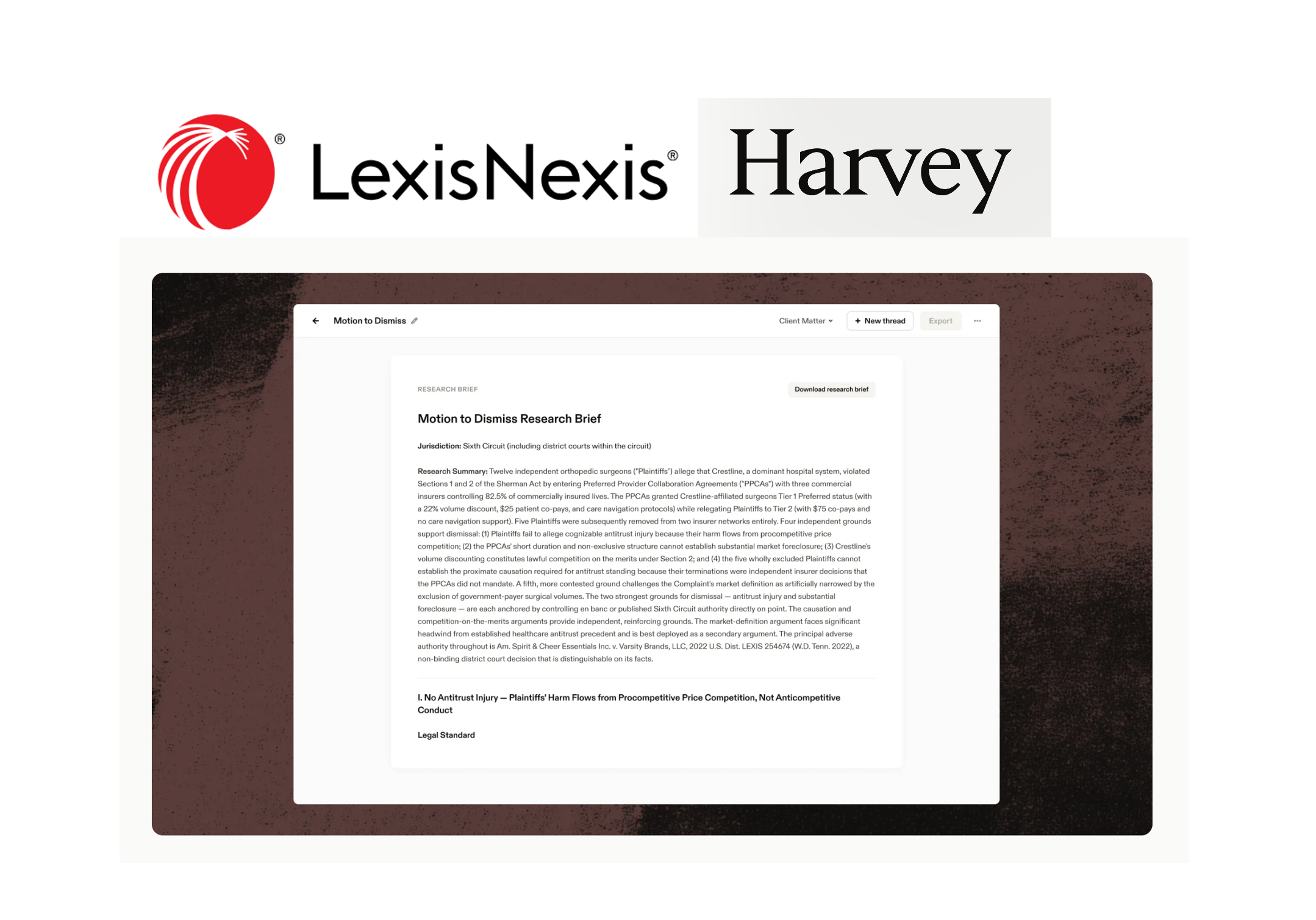
Harvey is launching a new agentic Motion to Dismiss workflow co-developed with LexisNexis, which follows last year’s legal data-sharing alliance.
What does it do? The short version is that it taps agents and Lexis data to help you to draft a fully researched, citation-backed motion to dismiss (MTD), which takes shape within Harvey, but is grounded upon LexisNexis’s horde of US case law, statutes, and Shepard’s citations.
Sounds useful, but how does it work? Here’s an overview
- The MTD workflow is agentic: a series of specialized agents plan, research, and draft in a review-and-approve loop, with human checkpoints at the moments where a lawyer’s judgment matters most.
- Harvey reviews the complaint and proposes a set of ranked arguments for dismissal. The lawyer approves or adjusts the plan.
- Multiple agents conduct in-depth research on each approved argument. A final agent drafts the motion.
- A planning agent reads the complaint and proposes a strategy. Harvey starts by identifying the forum and the governing law, then runs an initial research pass with LexisNexis US primary law to surface up to eight candidate grounds for dismissal.
- Harvey checks each ground against the specific elements of the claims pleaded — a missing element of a cause of action, a jurisdictional defect, a timeliness issue — while weighing the authority honestly and factoring in choice-of-law issues.
- Harvey then rates each ground by strength, so the lawyer can see at a glance where the complaint is vulnerable and where the motion may be strongest. It then produces a proposed strategy: a ranked set of arguments the lawyer can build the motion around.
As you can see, there is a lot going on here, which also underlines just how complex a MTD is – and how much work is needed to partially automate that workflow.
It’s also significant as it’s a co-developed product between Harvey and Lexis that goes beyond just sharing a slice of legal information. In turn this then makes AL ponder what other products they could build together.
And as Harvey notes, this type of data-backed agentic product can have a big impact because: ‘Drafting a motion to dismiss is one of the most time-intensive tasks in early-stage litigation. Typically, an associate has to read the complaint, spot viable grounds for dismissal, research each ground in the right jurisdiction, check for adverse authority, and draft 20–30 pages of intensely researched arguments.
‘This multi-step process commonly takes 40 to 50+ hours of work. The new MTD workflow streamlines this entire process — just upload the complaint, approve the strategy, review the research brief, and watch Harvey prepare your first draft.’
So, this is a big deal, both in terms of the product, and in relation to how these two companies are now working together in a more substantive way.
More here.
–
Meanwhile, California-based law firm Cooley has announced a collaboration with Google to develop a new Gemini Enterprise AI legal agent to help lawyers review court filings for confidential information and prepare proposed redactions. The move follows the recent roll out of Google’s own legal vertical capability – see here.
Cooley is the launch partner for this agent, they explained, and the firm is ‘providing product direction and ongoing feedback from litigators to help engineers design the workflow’.
Satish Thomas, vice president, Google Cloud, commented: ‘Testing our agents in real-world environments with Cooley’s highly-skilled team ensures we are solving genuine workflow challenges with the depth, speed, and precision legal professionals require.’
And in terms of the product, they underlined that it was one that really mattered: ‘Redacting court filings to protect confidential information can consume days of lawyers’ time reviewing documents and identifying sensitive information, with little margin for error.
‘Built on Google Cloud’s Gemini Enterprise, the new agent recommends targeted redactions of personally identifiable information (PII), technical information, and other potentially confidential material for attorney review. Attorneys make all determinations about what should be redacted before the filing is submitted to the court.’
So, another important collaboration, this time between an AmLaw 100 firm and a tech giant. Yesterday, AL reported on how OpenAI is building legal workflows with AT&T. Plenty happening now with the AI giants going direct to law firms and inhouse teams.
—
And now some more news in summarized Wrap style:
- PSA Solutions, a European legal tech group, and Crespect, an AI-native legal practice management and CRM platform, have announced that PSA will be an integration partner. Law firms running Crespect gain a ‘proven, local route to connect their practice management and CRM platform with the rest of their technology landscape, designed, delivered and operated by PSA as a managed service’, they said.
- Wordsmith has announced a partnership with Goodlawyer, a legal talent group that embeds experienced inhouse lawyers inside high-growth companies and enterprise legal teams. As they explained: ‘Together, clients get faster response times, broader legal coverage and more capacity for work that requires senior judgment, without sacrificing the relationships, context and accountability that make embedded counsel valuable.’
- Brazilian competition lawyer and former head of Baker McKenzie’s Latin America antitrust group, Paulo Casagrande, has launched SAÍRA, a RAG research system operating over a closed corpus of CADE decisions (last 10+ years) and reference literature, organised by source hierarchy. It uses public information only and contains no client data. Claude, ChatGPT and Gemini are part of the workflow.
- Peyton AI has launched an AI-powered triage platform for medical negligence claims, built to help law firms, malpractice insurers and hospital risk teams ‘learn in minutes whether a case merits further investment, a call that typically takes months of record review and an initial expert report’ they said.
- Michael Bommarito, the co-author of the seminal work ‘GPT-4 Passes the Bar Exam’ has joined the Unruly Corporation as Chief Innovation Officer. Bommarito worked on the 2023 study that first demonstrated GPT-4 could pass the Uniform Bar Exam and has also worked closely with legal AI guru, Dan Katz. CEO and Co-Founder of Unruly, Sean West, said: ‘Connecting geopolitics to rules and regulations requires true innovation to combine AI signals with human judgment and the corpus of law on the books. This is innovation I know Mike can deliver so Unruly’s clients stay ahead of policy shifts.’
- Legal research, drafting and analysis company Pandektes has announced a €13.5m Series A led by Alstin Capital, with participation from PROfounders, Scale Capital and existing investors. The Danish company said: ‘Pandektes applies legal methodology to how it researches and reasons. Answers are grounded in authoritative legal sources, with every step traceable and verifiable.’
- And, Litera has promoted Priyanka Singh to President, and Adam Ryan to Chief Product and Marketing Officer. Congrats to both.
And as mentioned:
Legal Innovators UK, on November 4 and 5 in London at the Minster Building, is right around the corner and Express Registration is now open so you can zoom straight to your tickets.
Day One will focus on law firms, and Day Two is for the inhouse world. Both days will also very much be about our great speakers exploring the cutting edge of legal technology; where we have got to with AI; and how all of this changes how you run your firm, practice group, or inhouse legal team.
To pick up your tickets, please follow the link below. Complimentary passes are for those working inside law firms and within corporate legal teams.

And there are many reasons to attend, from networking with literally hundreds of your peers, to hearing from those at the cutting edge of legal innovation – both at major law firms and corporates – to of course seeing all the latest capabilities that the leading legal tech companies have developed. See you there!
–
Just one video this week, but a good one! If you want to learn more about how an AI-native, new model law firm works, then check this out. Plus, in this case, Falcon is backed by Wim Dejonghe, the former A&O senior partner. P.S. Thanks to Matt Pollins and colleagues for hosting the great new model law firm event in London this week. So invigorating to see so many pioneering folks all focused on the same fundamental legal innovation goals!
–
That’s all for now. It’s going to be a very busy few weeks, with Legal Geek next week, then off to ClioCon in Boston, then Legal Innovators UK in London – Nov 4 and 5, and then Legal Innovators New York on Nov 17 and 18.
- Legal Geek – London – Oct 14 + 15
- ClioCon – Boston, USA – Oct 25 + 26
- Legal Innovators UK – London – Nov 4 + 5 – see here.
- Legal Innovators New York – New York – Nov 17 + 18 / (Nov 14 + 20) – see here.

And then hopefully a breather..!
Have a great weekend everyone and hope to see some of you at the above events.
Richard Tromans, Founder, Artificial Lawyer and Legal Innovators Chair.
Discover more from Artificial Lawyer
Subscribe to get the latest posts sent to your email.