
Imagine a law firm where the goal is to continually increase the speed of work for the clients by learning from each matter, thus creating a ‘legal data flywheel’.
Imagine a law firm where AI is used to its fullest extent, yet where a skilled lawyer oversees the work and maintains the client relationship.
Imagine a law firm that builds much of its own technology and can accept external investment to power their growth.
And of course, where the vast majority of that work is on a fixed fee and where the firm can sometimes waive its fee entirely if delivery is not on time – thus absorbing the risk twice-over.
Compared to the traditional Big Law model, which is built on billing as much time as the client will accept, plus a wide pyramid of human labour that churns those hours out, and where the client carries much of the risk as to the cost of that work, as well as where AI is used – but always hits a profitability barrier because efficiency reduces Big Law gains – then this is an evolutionary step of profound proportions.
Many such firms now exist. Two years ago they were rare. A year ago, such new models based on an AI native approach were just starting to be heard of more widely. Today, there are now dozens. There will be more. Far more. And all around the world. Would you like to be part of this evolution?
Moreover, the modus operandi of NewMod – new model – AI-native law firms are very much what Artificial Lawyer envisaged when this site first started a decade ago, as it quickly became apparent – even back then – that AI’s benefits would only be fully embraced if the legal business model changed with the arrival of that technology.
Today, 10 years later, the commercial legal sector is still grappling with those issues. The difference now is that a way forward has evolved – quite naturally, just as Darwin theorised – and now this new model species is part of the landscape.
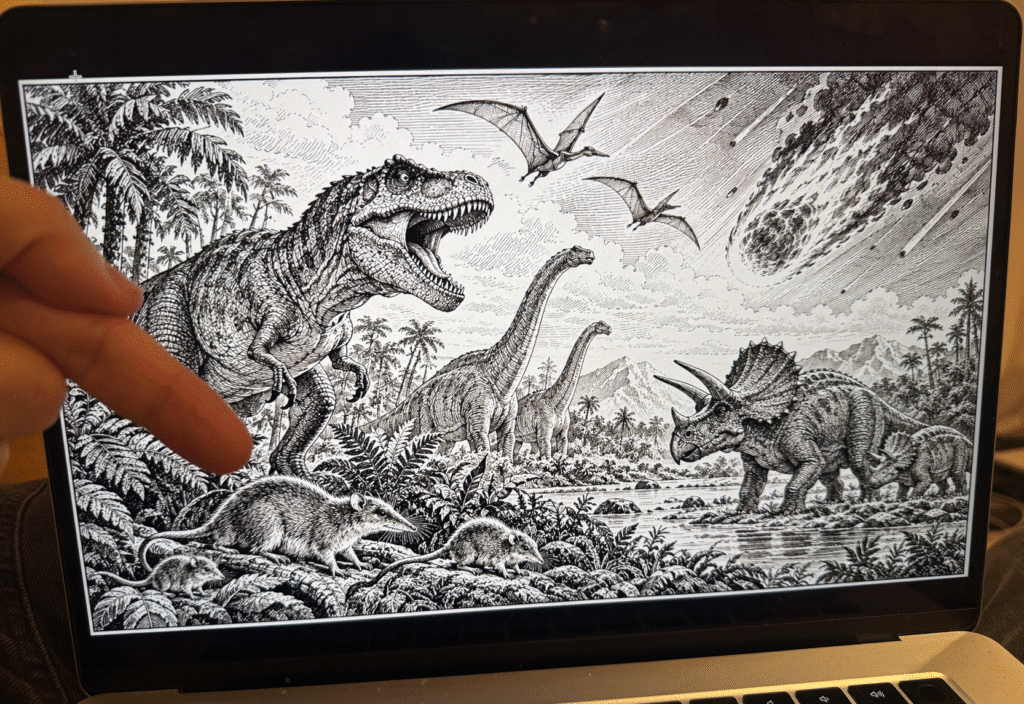
The wider question is: how much of the market can they take? Like mammals in the Cretaceous era, where the giant sauropods ruled the land, sea, and air, can they really take hold? And yes, we can forget that our more immediate ancestors lived side by side with the dinosaurs, often running between their feet and only coming out at night to survive. But, they did alright, albeit remained in small niches for some time.
However – and this will be the subject of another AL piece – it was wider environmental change that really opened things up. The early mammals didn’t eventually come to rule the Earth until the ecology that supported the sauropods shifted. After that it was the mammals who were best adapted, and they never looked back. (At least until the arrival of the late Anthropocene, but that’s another story.)
Falcon – An Example of the New Model
There are many new model, AI-native law firms now. But, Falcon, which has launched in Belgium and is backed by Wim Dejonghe, the former senior partner of Allen & Overy, is a very good example. See the video interview below with two of the founders, Amaury Gérard and Rémy Bonnaffé, who was a lawyer at Freshfields, which explores the business model and the technology they use.
Key aspects:
- Falcon brain combines LLMs, AI agents and proprietary legal playbooks.
- Clients can request contract reviews through Slack.
- Agents handle document intake, analysis, research and initial review drafting.
- A lawyer always checks, amends and signs off the work.
- A scoping agent identifies differences between AI output and lawyer revisions.
- A legal engineer reviews those differences for integration into playbooks.
- Playbooks accumulate knowledge about matters, clients and counterparties for future work.
- Their ‘legal data flywheel’ aims to reduce lawyers’ contract review time.
- Initial focus includes commercial agreements, data processing agreements and NDAs.
- Expansion plans include incorporating local legal expertise into Falcon brain in other countries.
- A future legal operating system would proactively identify clients’ legal issues.
And as Gérard explained: ‘The most important metric for us, is the time that a human spends reviewing a contract. The goal is really to decrease that as much as possible.
‘Our incentives will be aligned with our clients’ incentives.’
More about Falcon here.
Conclusion
The reality is that new model law firms will proliferate around the world. Many will focus on contract work because for now it’s a great entry point for this approach. That said, there are already some AI native firms handling more complex, higher risk matters. They will increase in number as well.
The direction of travel is both horizontal – into new practice areas; and vertical – up the value and risk curve.
If you want to join in this evolution there are two main paths and one much harder – but still possible – path:
- Join one of these new model, AI-native firms.
- Build one yourself.
- Encourage your law firm to become one.
This evolutionary story is just getting started.
Richard Tromans, Founder, Artificial Lawyer.
— Advertisement —
Legal Innovators UK conference – London – Nov 4 and 5, at the Minster Building – click below for your Express Registration, tickets are complimentary if you qualify.

Discover more from Artificial Lawyer
Subscribe to get the latest posts sent to your email.