
We start the Wrap with an exploration of the newly arrived SOM – or System One Model. A revolution that is sweeping the tech world, and which is now also making a lot of legal AI folks wonder what it can do for them.
Artificial Lawyer asked legal tech founder Len Hickey of Litigaze – and who has been working on SOMs, including for his own product – if he could set out what it all means so far. Many thanks to Len.
What is a SOM?
A SOM (System One Model or decision model) is a brand new type of AI model.
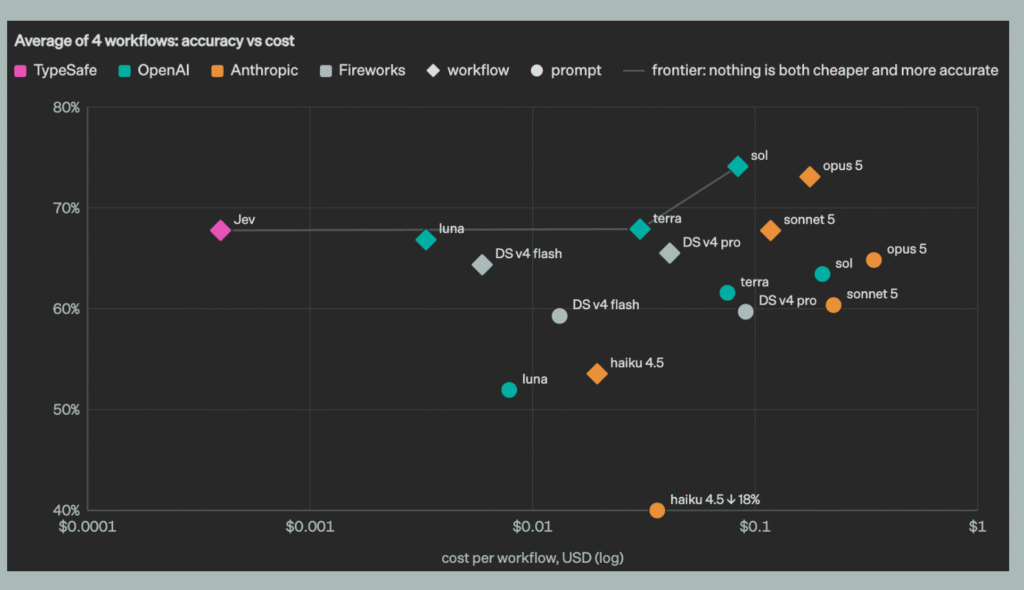
The first SOM, known as Jev, was released by TypeSafe AI on 15 Sept. Following the viral release of Jev, many new SOMs have appeared including most recently Cloudflare’s Clef model that was released on 1 Oct.
How are SOMs different from LLMs?
A simple way to understand SOMs is to imagine an LLM that can only answer questions by picking from a selection of possible answers you provide when prompting it. For example:
User prompt: ‘I got an email offering me $1 million with no catches. Is the email spam or not?’
LLM response: ‘Based on typical spam email content, it is very likely that the email you have received is spam.’
SOM response: ‘{spam: 95%; not_spam: 5%}’
Notably, while the SOM accepts a natural language input, the response it provides is not natural language at all, but rather computer code that represents the SOM’s underlying raw probability calculations.
In this sense a SOM does something similar to an LLM except that an LLM takes the extra step of converting its probabilistic calculations into generated natural language output for humans to read.
But LLMs are already very capable, so what makes SOMs interesting?
A key attraction of SOMs lies in the very fact that they can NEVER (by design) produce natural language output.
This may seem counter-intuitive considering how successful LLMs have become at using natural language to answer extremely complex questions (even Millennium Prize level math problems!).
But an LLM’s natural language output does have downsides. For one, natural language output opens the door to variability in responses, so that in practice no two LLM responses are ever guaranteed to be the same. Additionally, the extra step LLMs take to convert their underlying probabilistic calculations into human readable text takes real compute time.
What this means, in short, is that SOMs are more reliable, faster, and cheaper at the specific task they are designed for: answering questions about natural language input based on user-defined possible answers.
So the ‘spam’ example above is actually a very real use case for SOMs, as too are many other classification-type tasks. (Indeed for those familiar with traditional machine learning classification models, SOMs can be seen as general purpose classifiers that don’t require the costly and difficult training a traditional ML classifier does).
OK, but how does any of this relate to legal?
Given how new SOMs are (only a few weeks old!), their true value in legal is still to be determined.
But some use-cases seem pretty clear, and in those cases SOMs potentially represent an even more disruptive technology than LLMs have been.
For example, in eDiscovery one challenge with using LLMs has been the costs and delays associated with using an LLM across vast document collections.
While LLMs can already provide individual AI assessments on which documents in a set of, say, 1 million documents are likely to be subject to privilege claims, this has (until now) been a costly, slow, and tricky exercise with LLMs.
But with SOMs being dramatically faster and cheaper than LLMs, it’s now very realistic to have a SOM review 1 million documents to provide probabilistic privilege claim assessments without breaking the bank or blowing out deadlines. At Litigaze we’re already in the process of deprecating pay-as-you-go LLM review features to go all in on free SOM reviews (while also applying SOM tech for various other exciting new features…)
So should I ditch my LLM and become an SOM fanboy?
While the excitement around SOMs is no mere hype, it is important to consider that SOMs are still new technology and they will need time to be proven in real world use-cases.
Probably the biggest test for SOMs will not be on cost or speed, but on how accurate their probabilistic assessments turn out to be.
At the end of the day, Litigaze sees both LLMs and SOMs as tools for humans to use to help them make more informed decisions (which makes it somewhat unfortunate that SOMs have also been given the name “decision models”).
The future for SOMs is still wide open, but in the fast-paced world of AI technology Litigaze is not waiting for that future to be written by someone else!
Thanks very much! More on Jev and SOMs in Artificial Lawyer next week. Check out Litigaze here!
—
And now for some more regular news, which as ever will be kept brief.
The American Arbitration Association and Newcode, a configurable agentic‑AI harness built for complex legal work, are to collaborate. AAA ADR clauses will be made available directly within Newcode, enabling users to incorporate clear and effective clause language from the moment they begin drafting agreements.
By integrating AAA’s library of arbitration and mediation clauses directly into Newcode, legal and business teams will have access to established AAA clause language that can be incorporated into contracts, workflows, and agentic‑AI drafting tools, they said.
–
Leah has turned Vanderbilt Hall at Grand Central Station in New York City into Harmony Delivered, an immersive, multi-sensory experience that combines live music, light, sound and visuals inside a massive 30-foot circular installation. A video showing the activation can be watched here. (P.S. if you’ve done something very original on the creative side of things, drop this site a line. Maybe we can do a legal AI sector art competition?)

–
The inhouse focused ACC’s latest survey in Europe found that 83% are already using AI in their legal work, broadly in line with 85% globally. The technology is also beginning to change what legal teams expect to do in-house: 89% expect AI to streamline standard processes such as document review, while 64% expect reduced costs from outside providers. And that’s all to be expected these days, but good to see.
Meanwhile, only 11% of European legal departments track hard business metrics to measure ROI from AI, while 28% do not measure AI ROI at all. Also no surprises there.
But, what is interesting to see is that ‘AI is also starting to reshape legal careers: 31% of European departments are shifting junior lawyers towards higher-value strategic work, almost twice the global figure of 16%. Yet 44% have made no changes to professional development or hiring strategy.’
–
Levelpath, a procurement platform, has launched Ranger, an AI system built to ‘run entire procurement processes autonomously, including the contract review, renewal, and risk work’.
This is what it does:
- Autonomous Contracts and Renewals: Eliminates duplicate contracts and missed auto-renewal windows.
- Ranger computes each contract’s notice window automatically and launches the renewal review 30 days before expiration, recommending one of four paths (renew as is, renegotiate, terminate, or take no action) with a scored rationale for each.
- Unlike legacy agentic tools which require automation to be either on or off, Ranger allows organizations to choose which paths trigger human involvement and which can be executed autonomously.
- Contract Discovery: Lets teams ask a single question across up to 10,000 contracts and returns the answer with evidence cited back to the source document. And more.
–
OK, sometimes less is more. So now onto other things. Let’s highlight that Legal Innovators UK on Nov 4 and 5 in London, has now opened for Express Registration so you can get your tickets super-fast!
If you qualify you can very quickly receive your tickets for the landmark innovation event – follow the links below. Also, our Legal Innovators New York event is now doing the same. We look forward to seeing you on either side of the Atlantic to explore the cutting edge of the latest legal AI developments, what it all means, and the very latest products too!
Legal Innovators UK – Nov 4 and 5 / Legal Innovators New York – Nov 17 and 18
For London – Nov 4 and 5, at the Minster Building, see here:

And, for New York – Nov 17 and 18 – Midtown, please see here:
–
And now some webinars – both on the same day next week, so take your pick, or come to both! They’re free, but RSVP. Thanks.
iManage is holding a live webinar on October 8 at 10AM ET / 3PM UK time, to explore how ‘Context and Governance Will Shape Legal AI’s Future’. Artificial Lawyer’s founder will be moderating, alongside iManage’s Paul Walker and a surprise legal sector speaker to be announced shortly.
Overview:
- The AI Adoption Challenge
- Why Context Matters More Than Models
- Governance as a Competitive Advantage
- From Information Access to Intelligent Work
- Preparing for an Agentic Future

—
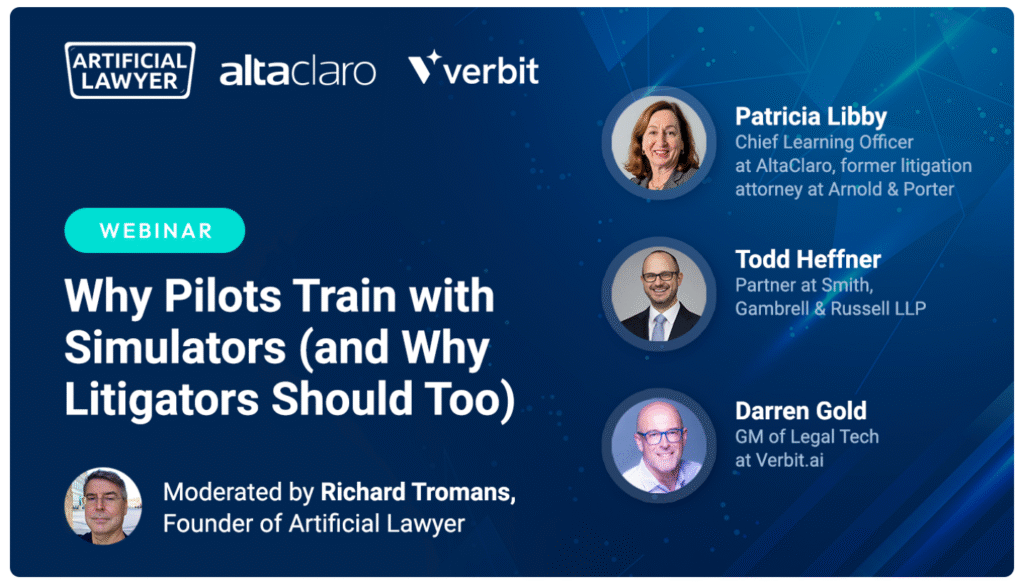
And, a live webinar with AltaClaro and Verbit on the subject: ‘Why Pilots Train with Simulators (and Why Litigators Should Too)’ – 11 AM ET, 8AM PT, 4PM UK also on Oct 8.
Can lawyers learn from how other professionals train, such as pilots? Can simulators become a key part of training for lawyers, especially for litigators? You bet! On October 8, Artificial Lawyer will be moderating a live webinar with AltaClaro and Verbit on the subject: ‘Why Pilots Train with Simulators (and Why Litigators Should Too)’.
The live discussion, which takes place at 11 AM ET, 8AM PT, 4PM UK on Oct 8, and will cover:
- Why deposition skill decays without recurrent practice, and why litigation has ignored that reality longer than any other high-stakes profession,
- What aviation, medicine, and elite athletics can teach litigation about training and sustaining performance under pressure,
- How simulation-based learning creates the deliberate practice that keeps instincts sharp between live matters
—
And that’s all for this week. Artificial Lawyer will be travelling to Paris on Monday, and back late on Tuesday, so news will be a bit disrupted those days. But, if you’re coming to our Legal Innovators Breakfast at Le Train Bleu in Paris then I will see you there! À bientôt!
Have a great weekend folks!
Richard Tromans, Founder, Artificial Lawyer, and Legal Innovators Chair.
—
Discover more from Artificial Lawyer
Subscribe to get the latest posts sent to your email.