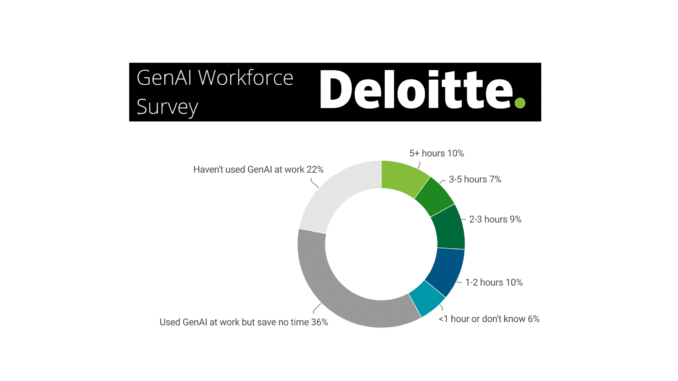
A major survey of 25,000 employees by Big Four firm Deloitte has found that the workforce in general has not seen significant productivity gains from AI – which makes Artificial Lawyer ask: is legal different?
First, let’s look at what the survey of staff in the UK said. The primary finding is that although most people now use AI at work, the majority see very small gains in terms of time saved. Below is the chart for finance, banking and insurance – as there is no special chart for law.
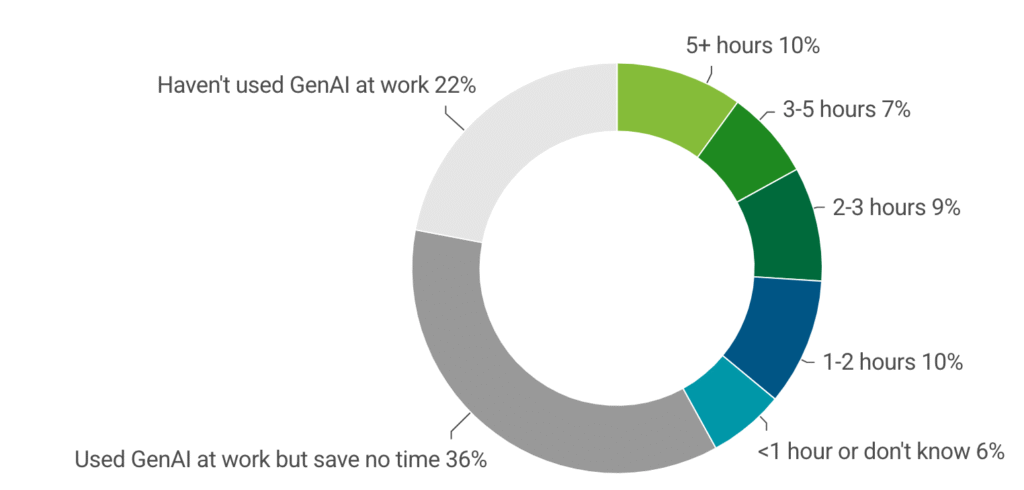
As you can see, only 10% saw time savings of more than five hours per week. If someone is perhaps on a standard contract of 40 hours, then five hours is significant, i.e. 1/8 of their weekly work. If more senior, or in a more demanding area, and working much longer hours, e.g. in investment banking, then even five hours per week is not that great.
Also, only a quarter of staff saw time savings of more than two hours per week, with over one-third saying they used AI, but got no time back from using it.
When you look at what AI is being used for one can perhaps see the problem. Searching for information (most likely tapping the web in general), summarising information, and finessing emails are the top three reasons people are using AI at work.
None of those tasks are that significant, unless your entire job is finessing emails. And most people don’t spend their working lives doing that.
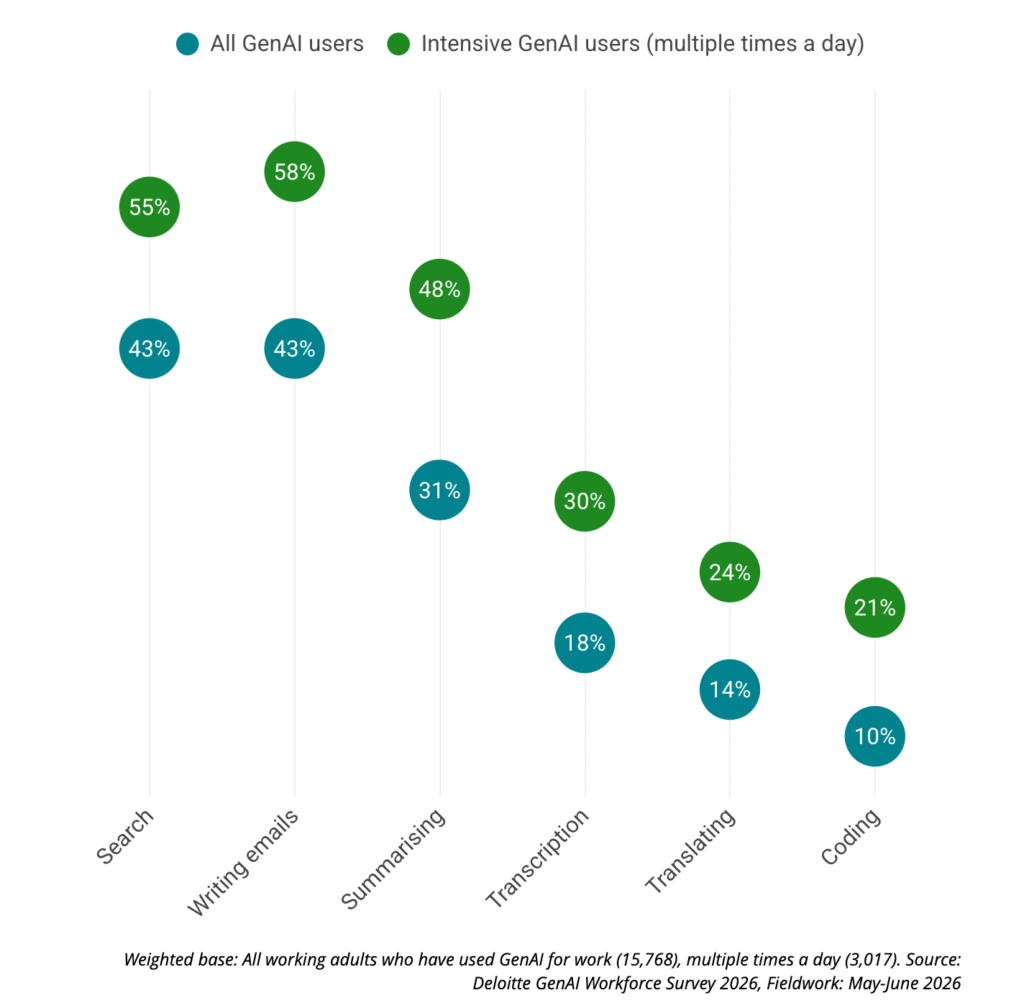
What this also tells us is that the deployment of AI at present, at least in the UK, is surface level. People are using AI as if it’s Google search with some added minor drafting capabilities. And to be frank, Google has already evolved to the point that just in the regular search environment you can tap its AI to do more complex things.
But, if you are not really embedding AI into workflows, then it’s no surprise the impact is small. This is perhaps the result of senior management believing that ‘just having AI’ will magically make a difference. It won’t.
Using AI is a ‘new way of making things’. You have to redesign the workflows to incorporate AI. In fact, if the tasks where the technology is applied are going to be more than single prompt-based demands, (i.e. low impact), then you are going to have get agentic and build for long-horizon, continuous / high frequency needs. Then you can really make an impact.
In short, if you just sprinkle a very light prompt-based approach to AI over a well-developed business that already has its own long-established ways of working, then you cannot expect staff to provide a significant change.
— Advertisement —
—
Is Law Different?
No doubt there are plenty of law firms that are also using AI in the same ‘sprinkles’ way. And they also will get small returns as a result.
However, legal work is very receptive to AI. Why? Because it’s all about language understanding, the review of huge amounts of text, and the production of equally huge amounts of contracts, briefs and other complex documents. In fact, law is text. Law is language. Law is all about concepts embedded in 10,000s of pages of rules, regulations, and previous matters.
Legal work is also made up of dozens of very complex, but nevertheless formalised, workflows, with as noted, text as the main medium. AI can have an impact here in ways that perhaps the work of other people across the economy may not experience.
For example, a review of many documents using AI would save you more than five hours just on the first day of using that tool, let alone across a week. Legal research, perhaps with some added AI drafting applied, could also make a huge difference. And so on. Legal work can truly be impacted positively by AI.
Conclusion
First, legal work is different to selling insurance or ringing investors to see if they want to be part of an IPO. Legal is very human-centric, for sure, but the fundamental material of law is text, and AI loves that medium more than any other.
Second, from what Deloitte has found, many corporates are not applying AI to the work their staff do in a meaningful way. They are ‘sprinkling’ it over roles, without that activity changing. Clearly many people are using something like an enterprise version of ChatGPT to do web search, or read documents they don’t want to read, or make nicer emails. But, that won’t move the dial.
Consider this metaphor. If you buy a book for a friend on how to get fit, it doesn’t lead that person to becoming an athlete, or even getting fit…! They may flick through the self-help tome, acknowledge the bit about being more active and close the book again with the intention of walking a little more each week. But, as you can guess, in most cases any improvement is small. I.e. it’s all surface.
Law is doubly in a better position here. It seems that many law firms and inhouse teams are more aware today of what AI can do that has a real impact, and they do the type of work where AI can actually provide a real difference in productivity.
But, whether it’s the law, or another sector, you need more than ‘AI sprinkles’ if you want real change.
More about the Deloitte survey here.
—
Legal Innovators Conferences London and New York this November
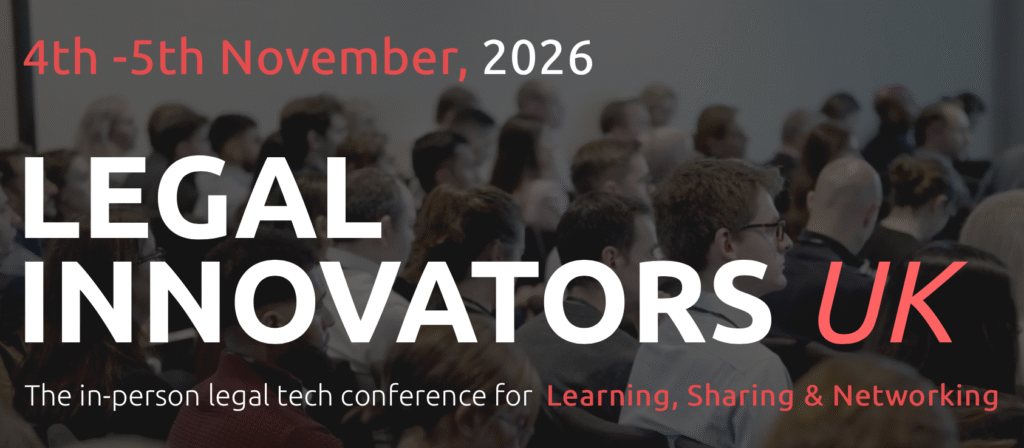
Come and join us in London this November 4th + 5th at Legal Innovators. The conference at the intersection of legal AI and the business of law. Day One: law firms, Day Two: inhouse.
Legal Innovators UK – London, Nov 4 and 5
And,
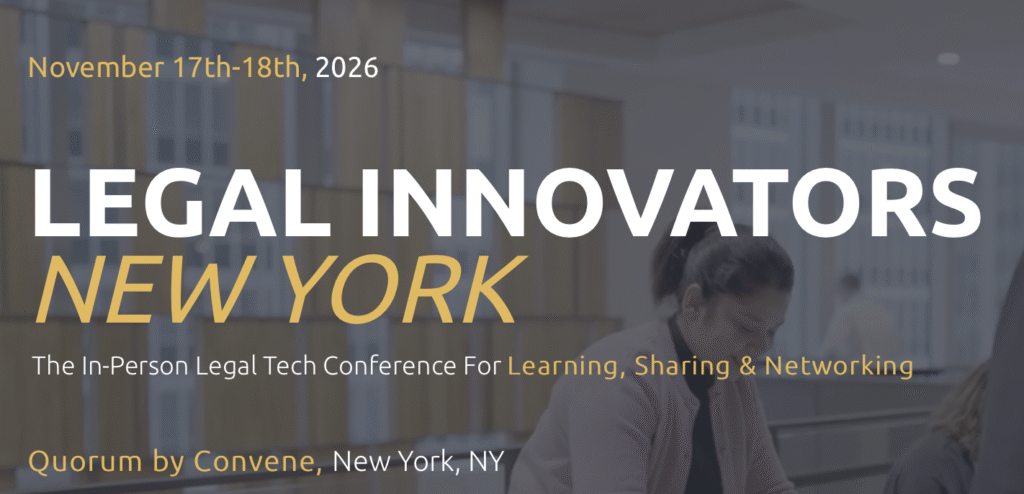
Legal Innovators New York – Nov 17 and 18
See you at Legal Innovators New York – Nov 17 and 18 – join us at the intersection of legal AI and the business of law in New York for the most important legal innovation event of the year! Day One: law firms, Day Two: inhouse. Top speakers from across the legal AI world, leading law firms, and major companies. All for one purpose: to describe and explore the frontier of legal technology. See you there!
UK and New York event links are here:
Discover more from Artificial Lawyer
Subscribe to get the latest posts sent to your email.