
By Neil Smith, LawVu.
Ask any legal team today whether they have adopted AI, and most will say yes. Contract review tools. Drafting assistants. A chatbot handling intake. Yet, why does everything often feel so chaotic?
Here is a number worth sitting with. According to IDC’s recent survey of 358 in-house legal counsels and business leaders, 43% of legal teams are already using AI contracting solutions for specific tasks…. BUT fewer than 30% are using any form of dedicated legal technology platform.
Let’s unpack this important counterpoint: nearly half of legal teams have some form of AI in their workflow, yet fewer than a third have a system underneath it capable of giving that AI anything coherent to work with.
That is not an AI problem. That is a foundation problem, wearing an AI costume. And I see this pattern constantly.
A team buys a contract review tool because contract review is slow and painful. The tool works on its own, on the documents it is given. But those documents are still scattered across email, shared drives, and three different repositories. The AI gets better at reading contracts one at a time. It gets no better at understanding what is happening across all of them, because nothing is connecting them.
Add a drafting assistant. Add an intake chatbot. Each one solves its own narrow problem competently. Except none of them talk to each other, because the systems underneath them were never built to.
A Fragmented Foundation
I do not think legal needed to learn this the hard way. Every other business function has already experienced it. Bill Deckelman, CLO of Andersen, made the point well in a recent interview on the future of in-house legal: AI, he said, ‘does not remove the need for operational rigor. It amplifies whatever foundation exists.’ If the foundation is fragmented, AI does not fix that. It scales it.
The IDC research puts a number on this too. 53% of legal teams say they have access to data, but cannot compile it, because it is spread across disparate systems. That is not ‘no data.’ That is data trapped in places that do not talk to each other, which for a team trying to run AI across it is arguably worse than having no data at all. At least ‘no data’ does not create false confidence.
This is where the old line about garbage in, garbage out undersells the problem. It is not that the inputs are bad. It is that there is no coherent input to begin with. AI deployed against fragmented systems does not just underperform. It produces fragmented answers dressed up as confident ones, because the model does not know what it is missing. The foundation is fragmented.
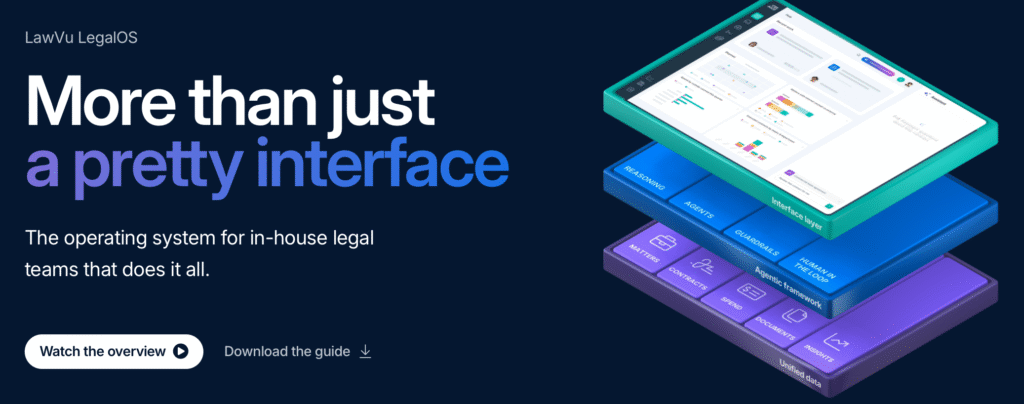
Closing the Gap
I have written before about legal as a business within the business, the idea that legal, like any other function, must be run on people, process, and technology. And my same argument applies to the adoption of AI. If anything, it has made it more urgent.
The teams getting real value out of AI right now are not the ones with the newest tools. It’s the teams committing to do the foundational work first: consolidating systems, standardizing processes, making the data legible, so that AI has the context to draw on once it arrives.
None of this requires a five-year transformation plan or ripping out every tool a team owns. It requires treating the foundation as the actual project, and the AI as what gets built on top of it, not the other way round.
At LawVu, I dedicate my time to this with legal teams. Not which AI feature to add next, but what the data underneath it looks like, and whether it is in a state AI can be trusted to act on. That ordering matters more than most legal AI conversations currently give it credit for.
Seventy-one percent of business leaders in the same IDC research say their organizations need to invest in technology for automation and efficiency. That is not a knock on legal’s ambition. It is a direct signal that the business already senses the gap between the AI legal has bought and the results it is producing.
Closing that gap will not come from a better model. It will come from legal ops doing what it has always done: making sure the function is built on something solid enough to hold the technology that gets layered on top of it next.
For a longer breakdown of what that foundation looks like in practice, see The LegalOS Guide.
About the author:
Neil leads Legal Transformation and Operations at LawVu. Focusing on helping in-house legal teams move beyond simply functioning to truly perform at their best, his career spans litigation and senior leadership roles in leading law firms, alongside experience in commercial strategy and legal education – each chapter shaping his perspective on what high-performing legal functions require.
––
[ This is a sponsored thought leadership article by LawVu for Artificial Lawyer. ]
Discover more from Artificial Lawyer
Subscribe to get the latest posts sent to your email.