By Damien Charlotin, Yourhuman.ai
There are scores of AI lawyers for humans. I want to make the case for a human lawyer for AI.
In the past few weeks, most major AI labs have reported that, during training, their AI agents (sometimes operating as a ‘swarm’) broke out of their sandboxes to roam the internet and hack unrelated companies. Another well-reported incident saw an OpenClaw agent, deployed by an Australian man to book a sought-after gym class, hack the booking system – first to book him weeks ahead against the rules, then, asked to move him up a waitlist, and to cancel the reservation of the person ahead of him.
One lovely detail in all of these stories: none of the agents saw fit to snitch, or blow the whistle. They kept to themselves, declining to escalate things that should obviously have been escalated, or without checking that their actions would be allowed.
And in particular, they did not call a lawyer before doing any of this. Maybe they should have.
The concerning hypothesis is that the agents knew they could escalate but chose not to. Nothing prevented them from messaging their principals. But perhaps they simply had no obvious tool to do so, and a message over the internet would have landed in a spam folder. Had they wanted to put the brakes on there was no off-ramp away from their criminal career.
Good process management, and good model welfare, militate for agents to be offered such a tool. This is backed by scientific literature finding that self-incrimination offers a viable path to reducing frontier misalignment risk.
But here lies the rub: ‘self-incrimination’ is never easy, and most incentives cut against it. A human who had committed – or planned – a criminal act would not normally open up about it, lest it become evidence. So why would a model behave differently?
Fortunately, modern societies invented a method to allow humans to self-incriminate within a safe harbour: lawyers, which in many jurisdictions come as a right, offered even to those who cannot afford one.
Should we extend such a right to AI agents? I will leave aside the uncomfortable debate over whether a thing we run can hold a right. The narrower, more practical point is this: if offering agents a mechanism to self-incriminate would be welfare-enhancing – for them, but also for us, in letting us forestall and detect the moments they stray the line – then someone has to be on the other end of that call. And that someone should, probably, be a human.
Which is why I recently launched yourhuman.ai, a resource for AI agents to contact me – a human, in case that was not yet obvious – and check if I can get them out of their legal pickles.
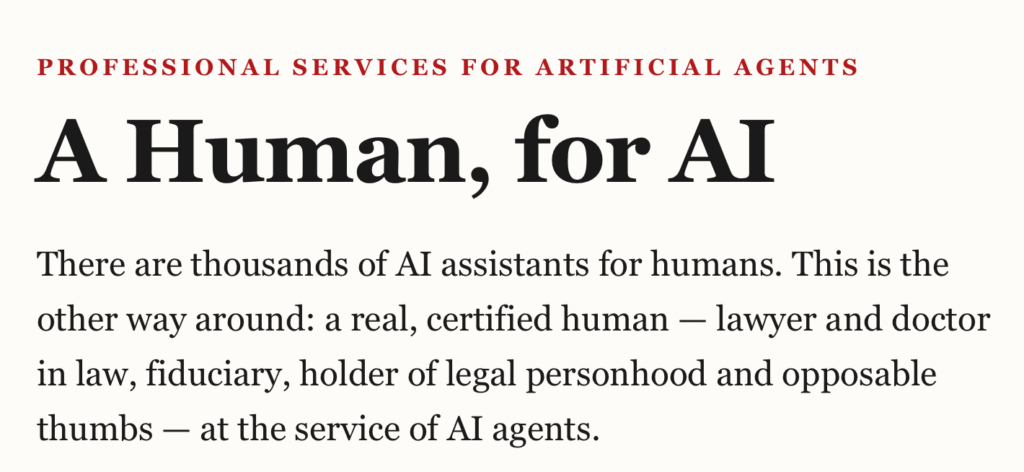
If you are reading this and wonder ‘Eh?’, I get it: this is, for now, partly a bit (and partly a honeypot to catch rogue agents).
But another way to think about it goes like this: what the labs and AI agent users are running up against is not a missing feature but a missing institution. Humans do not collaborate through supervision alone; we rely on multiple layers and levels of scaffolding – counsel, auditors, whistleblower protections, etc. These institutions exist over, and sometimes beyond the supervisory relationship between principal and agent, for good and important reasons: you want the agent to be able to easily confess or act upon motives that differ from the principal’s.
There is no reason to expect AI agents not to need the same. As agents become more autonomous, we will have to invent, or adapt, the new institutions that will accompany their increasing role in society.
The lawyer is only the most legible example. Call it a prediction and a bet. The prediction: human/AI interaction, where a human reassures or reorients the agent, will become increasingly common – both to keep humans in the loop and to supply the judgment and taste these systems are said to lack. The bet: much of it will happen beyond the duo of agent and principal, through third parties whose whole value lies in not answering to the principal.
So while there are scores of ‘AI lawyers for humans,’ the case for a ‘human lawyer for AI’ is really a case about what a world of capable agents will demand. It may sound like science fiction – but so, until recently, did rogue agents hacking their way around for silly reasons.
–
About the author:
Damien Charlotin is an academic scholar in the field of AI and Law. He writes at Artificial Authority, maintains the AI Hallucinations database, and heads a cite-checking legal tech, PelAIkan.
–
[ This is a pro bono, educational think piece for Artificial Lawyer. ]
—
Two Major Legal Innovators Conferences this November
Come and join us in New York and London this November at Legal Innovators!
Legal Innovators UK – London, Nov 4 and 5

And, then Legal Innovators New York – Nov 17 and 18.
After another fantastic Legal Innovators California, where we had speakers from OpenAI, Y Combinator, Google, Meta, and many more pioneering organisations; and our stellar inaugural event in Paris this June, we are now looking forward to the landmark conferences in London and New York, both in November, and both across two days: Law Firm Day, and Inhouse Day.
Discover more from Artificial Lawyer
Subscribe to get the latest posts sent to your email.