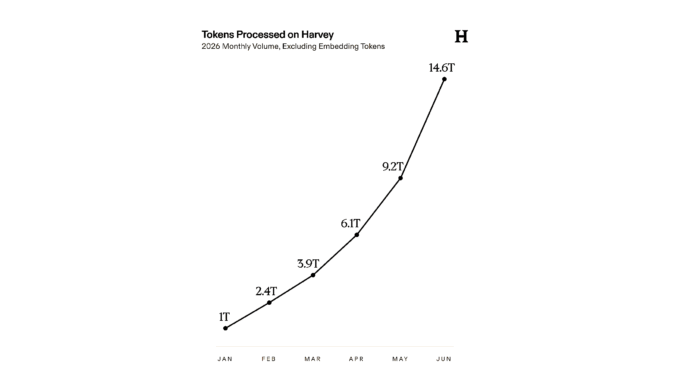
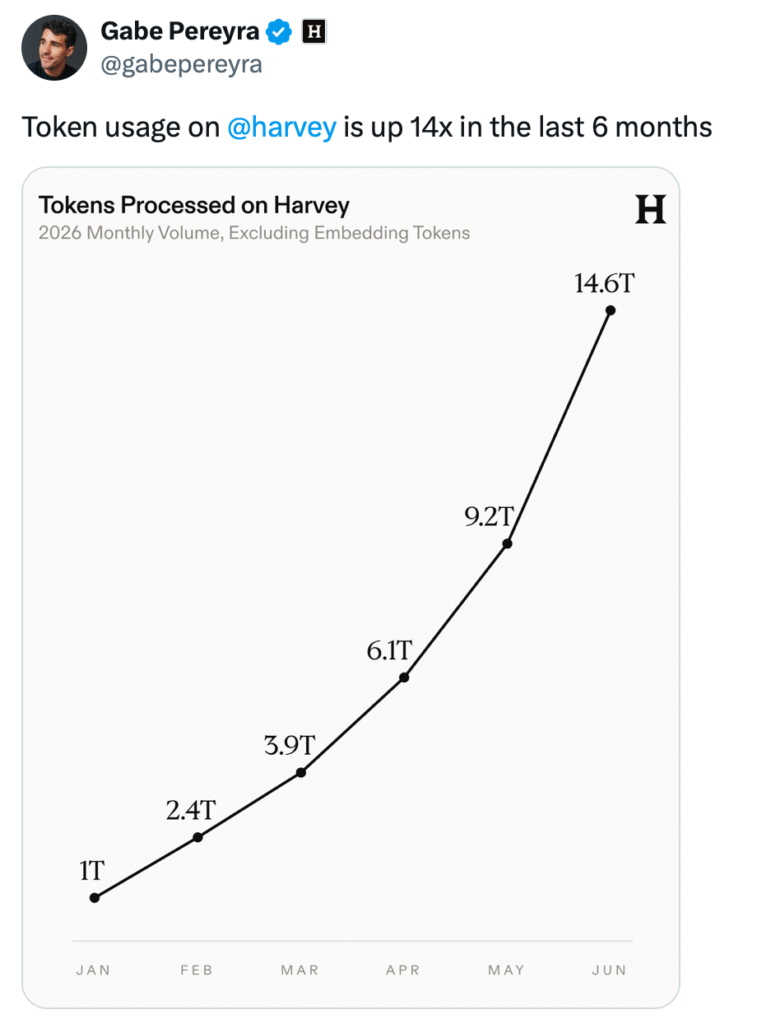
Harvey’s co-founder and President, Gabe Pereyra, has announced that the number of tokens processed on the broad legal AI platform have increased by fourteen times in just the last 6 months – proof of how much AI usage is increasing. What does it all mean? AL explores.
The usage data does not include embedding tokens, nor does it show the costs of this growth at Harvey, which is understood to be developing a new pricing model for customers.
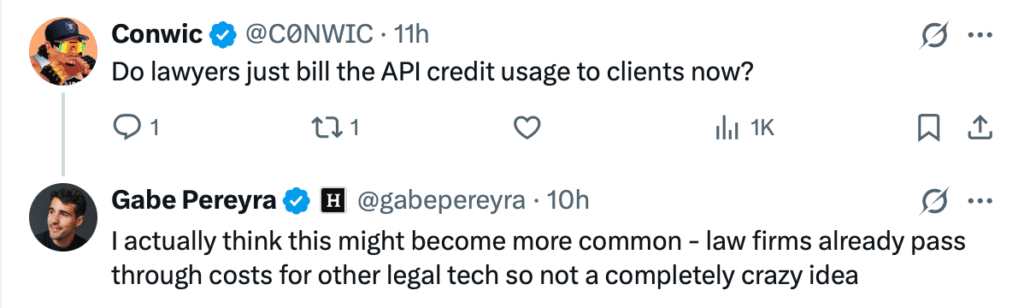
Interestingly, when Pereyra was asked by one poster on X about law firms passing through token costs to customers, he replied: ‘I actually think this might become more common – law firms already pass through costs for other legal tech, so not a completely crazy idea.’
So, what does all of this mean?
First, it comes amid a background where main rival Legora has announced it’s moving to a pricing system that will take into account token consumption; where clearly it’s a fact that more people and more businesses in general are using AI more frequently; and where the latest models, such as Fable, are increasingly sought after because of their better performance – but in turn create higher costs. And AL is also hearing increasingly that clients want their law firms to reduce their bills because they’re using AI…!
Plus, of course, we now have Claude for Legal, Codex for Legal, and Perplexity also seeking to expand its legal tech engagement. And we are seeing both law firms and legal tech companies now building open source offerings – which could reduce costs – and that includes Harvey.
The fundamental issue here is that not all tokens cost the same. For example, using the most advanced models’ deepest reasoning capabilities on a very complex legal matter not just uses a lot of tokens, those tokens cost more. Agentic tools increase costs even more, as agents can tend to go back, and back again, to do the same task in order to get the best result.
The problem lawyers have is that they tend to avoid risk – and that’s a good thing. But, if I say: ‘You can use A approach which is cheaper, but may make more mistakes, or B, which is expensive, but benchmarks show it performs better….which do you want?’ The lawyer will likely say B.
One cannot offer a more accurate tool to lawyers and then expect them to accept a less accurate tool, aside from where the improvement is either negligible or where accuracy is not such a critical issue. Although, when is accuracy never an issue for legal work…?
Now, one could argue that the legal AI platforms have an advantage over the main model providers that are doing legal as well, as you can quickly reroute calls to multiple models, from a very wide range of providers. That keeps costs down. Just getting stuck on Fable for all your Claude Legal tasks could conversely be very expensive, and will a user be ready to keep switching in and out of different Claude versions to keep costs down?
Then we get to the pass through point noted above. And it’s a big one.
Like the billable hour, tokens are fast becoming the new currency of the legal world today. Should law firms pass on those costs?
One could argue that clients always pay most law firm costs, regardless of how it’s packaged up. After all, law firms only make money from sending out those bills, and those bills are designed to keep their profit margins at a certain level.
So…maybe it’s a moot point. If legal AI costs rise, the costs will be passed to the clients, come what may, whether explicitly or implicitly.
Which then leads to the final point: if AI costs go up and corporates use AI more, then do they just bring more and more legal work inhouse so they can at least have some control over it?
Or, do the external legal providers eventually enter into a price war in order to keep certain work streams? And that in turn creates a price war for the legal AI companies? I.e. a bit like how inflation leads to supermarkets putting pressure on farmers to sell wholesale goods more cheaply. In short, everyone gets a margin squeeze?
I.e. we get a legal AI token cost arbitrage battle, where some GCs decide to bring as much work inside as possible to have some control over costs – if they have a sophisticated approach to model routing; while other GCs stay with external advisers for nearly everything but start pushing back on bills and pick firms that swallow their token costs?
Conclusion
We are entering a new era for the legal business model. It’s not just that AI will change the internal workings of the pyramid, it will change the cost-base of the work done, and then in turn the allocation of those costs.
At present it’s chaotic. Clients want price cuts from law firms for using AI, just as the cost of using those AI tools increases. Main model makers are wading into the legal market as well, just as the legal tech world grapples with rerouting to save itself money on token costs. Things are moving in opposing directions all at once. That is not sustainable in the long-term.
In short, the market is in flux and token maxxing is at the heart of it. Stability will have to arrive at some point and there will be winners and losers when that happens.
Richard Tromans, Founder, Artificial Lawyer.
–
More about Harvey here.
–
Come and join us in New York and London this November at Legal Innovators!
Legal Innovators UK – London, Nov 4 and 5

And, then Legal Innovators New York – Nov 17 and 18.

After another fantastic Legal Innovators California, where we had speakers from OpenAI, Y Combinator, Google, Meta, and many more pioneering organisations; and our stellar inaugural event in Paris this June, we are now looking forward to the landmark conferences in London and New York, both in November, and both across two days: Law Firm Day, and Inhouse Day.
Discover more from Artificial Lawyer
Subscribe to get the latest posts sent to your email.