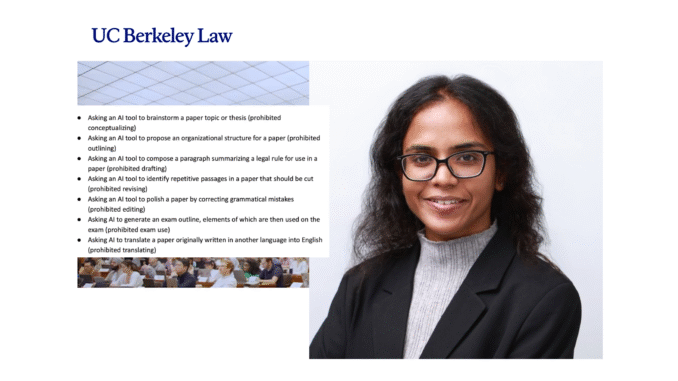
Last month, Berkeley Law School controversially banned AI use across many areas of study. One student, Lakshita Bhargava, who is doing a Master of Laws with a focus on AI Governance at the top US college, told Artificial Lawyer what she thinks.
First, the prohibitions. As AL covered in May, (see list of banned areas below), the Californian law school decided it would halt large swathes of AI use in order to help its students avoid depending on LLMs.
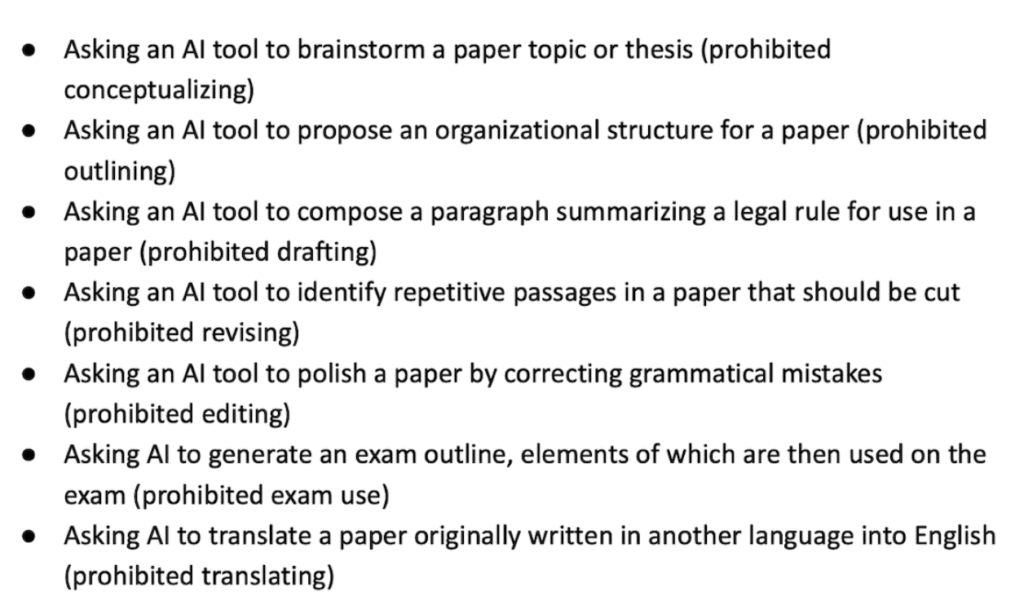
The goal was well-intentioned: to protect intellectual development. However, there are plenty who believe the move is missing the bigger picture, namely that AI is here now, and therefore law schools – and everyone else – need to find ways to bring it into daily use effectively and safely, rather than trying to block it.
Here, Bhargava, who most recently has been working at leading Indian law firm Shardul Amarchand Mangaldas & Co, set out her views to AL.

‘Firstly, I understand the concern for the professors, [but] a permitted-but-disclosed model creates better accountability and feeds into learning.
I am doing a Master of Laws with a focus on AI Governance. It leads to the same LL.M. degree as the traditional Master of Laws, but my coursework is concentrated for professionals and is only in the summer.
The same AI-use rules apply to our summer exams as well. The policy was prepared by one of my professors from the Law Department.
An ideal AI policy for law schools should have two urgent goals: to help students use AI productively (i.e. understand its correct use); and to protect the integrity of legal education (i.e. skill acquisition for future work).
To do that, this should cover three core things:
First, to make students understand AI is only as good as you are they should treat it as an intern/assistant and use it only for those tasks that current LLMs do well. This creates a clear use-based framework for only low-risk learning support such as summarising, outlining, editing, translating, and study preparation.
Second, it should require meaningful disclosure of AI use, of any kind. This is urgent and will uncover power users. This approach helps maintain both integrity and feeds into how the school understands how students actually use AI, and that in turn can help to improve future policy-making.
Third, it should definitely focus on setting concrete safeguards, such as no confidential or sensitive information used in any tools, mandatory verification of citations and claims (which helps students to learn what are the elements required to verify), and full student accountability for the final work, which forces them to learn in class.’
—
AL would add that this is a balanced approach and this site especially likes the point about disclosure of AI use. I.e. if you tell students that using AI for areas such as brainstorming ideas is ‘forbidden’, many will just do it any way – as everyone has access to free AI tools – but they will not tell the law school. Paradoxically, it could even encourage more unquestioning acceptance of AI responses, as discussion of the results would not take place.
I.e. if you say, ‘Go ahead, but be open about where you’re using AI, and then let’s discuss where you have got to in your thinking and what the AI inspired,’ then both the student and the professors know what is actually happening. It makes AI a tool to help learning, rather than seeing it as the enemy of education.
Ultimately, one could say that censoring the use of AI in education is a bit like banning certain books from libraries. People will still find those books. A better approach is to widen the students’ minds so that they can have a more rounded understanding of any material they consume.
Also, as Dr Megan Ma at Stanford Law told this site during a recent webinar, AI can help widen a student’s understanding of legal issues. I.e. AI supports learning as it provides counterpoints that a student may not be aware of. In short, used transparently and wisely, AI is an aid to education. Banning it just drives it underground where its use will be invisible to the professors, but take place nonetheless.
What do you think?
–
Here’s more on the Berkeley Law AI rules here.
–
Discover more from Artificial Lawyer
Subscribe to get the latest posts sent to your email.