
Harvey has unveiled details about Spectre, its company agent that is starting to autonomously handle a range of tasks inside the business. It points to the future of the legal sector and the potential for a ‘law firm world model’ that handles most ‘intelligence work’.
President and Co-Founder of Harvey, Gabe Pereyra, notes in an article this week that today ‘much of what Spectre does is no longer triggered by a human prompt. It is triggered by the system monitoring the company and making decisions based on incidents, bug reports, customer feedback, and Slack messages’.

I.e. the agent here is truly ‘agentic’ – it is activated not by a human telling it each and every time what to do in every scenario, it is acting on its own – at least in certain domains – because ‘it knows what to do’. In short, the workflows, the knowledge of how to act, and what to act upon, have been crystallised.
Now, that’s impressive, but that’s just the start of things. As Pereyra explains in his piece, once you can do what Spectre does, then it opens up a whole new way of looking at business organisation, and that will include how law firms and inhouse legal teams function.
This outlook is embedded in the idea of what is called ‘a world model’, i.e. a framework that allows agents to both ‘see’ and operate across the whole business, tapping all the data and activating all the workflows it needs to carry out a myriad of tasks.
‘In practice, Spectre is the beginning of a company world model: a live picture of what is happening inside Harvey and what needs to happen next. Our engineers are now so productive that they are harder to coordinate.
‘The bottlenecks are shifting away from implementation and toward review, prioritization, coordination, and operating design. That is what the new leverage looks like inside an organization: more work can happen than the old coordination structure can absorb.’
And this in turn opens up another major shift in organisational thinking and points the way not just to an agentic company world model, but a law firm world model as well. This is because the principle is the same. If this approach can work inside Harvey, it can work inside a law firm, or an inhouse team.
But, for now, let’s go back to the central point here: a real change in the means of production, and thus an equally major change to organisational structure.
Before, we could only move as fast as the junior members of the business could handle the work needed to move forward – as inevitably one’s pyramidal organisation operates that way. Now, with these automated agentic flows, work needs can be met many times faster.
In fact, as Pereyra notes: ‘With the ability to hire infinite AI employees, companies will stop being constrained by throughput….This requires fundamentally rethinking what work matters, how to review it, how to trust it, how to train people around it, how to price it, and how to redesign organizations around a surplus of intelligence bottlenecked by judgment.’
And let’s repeat that last phrase, as AL would like to say it really is a great encapsulation of what matters now in terms of thinking about legal sector market evolution: ‘A surplus of intelligence bottlenecked by judgment.’ That is the law firm business model in a nutshell. I.e. the partners, who are the higher judgment layer and importantly also own the law firm and thus control access to the associate leverage that does the majority of the work, are the bottleneck. The intelligence work, under the current manual labour pyramid, is essential for any client matter. To access that productive engine (which today are junior lawyers) you have to go through the partners, AKA the legal business owners. Like the industrialists of old, partners control access to the legal engine that will do the majority of the hard (if not process-level) work and make the ‘products’ for the customers.
The problem we have, at least as far as AL sees things, is that this bottleneck has become super-profitable for the partners who control this constrained pathway that 1000s of companies need to pass through. They don’t want to give that up, not unless this new agentic future gives them something even better.
This then leads to the potential for a real shift, and one that will absolutely change things for law firms. If an organisation’s ‘labour’ leverage is now in part replaced with agents, then the thing that really alters whether a business can perform well or not is now all about coordination.
Or put another way, if your means of production in a knowledge business has become largely ‘agentized’ [ AL can’t think of another word for it,] then the bottleneck is no longer human labour – even if that labour is cerebral – or the ability to access it, but rather whether you can, to put it simply, make all the components of your business work together. I.e. organisation itself becomes the central challenge.
One analogy AL came up with is: think of a car, and then break it down into all of its components. If those key elements of the engine, the drive train, the wheels, the brakes, the fuel tank, and so on, cannot be connected safely to the chassis (i.e. the business in this example), and to each other in the right way, to form a single integrated operating system, then the car will fall apart and you won’t get anywhere.
Or, as Pereyra puts it: ‘Meaningful leverage under these conditions is no longer about how much one organization can produce. Rather, leverage is found in how much context people, teams, and institutions can coordinate across humans and agents.’
Agentic Futures for Legal
OK, so, how does this connect to legal? Well, law firms are heavily dependent upon a pyramid of ‘intelligence’ labour, with an upper pyramid section devoted to ‘judgment’, (see Sequoia paper + AL analysis article here).
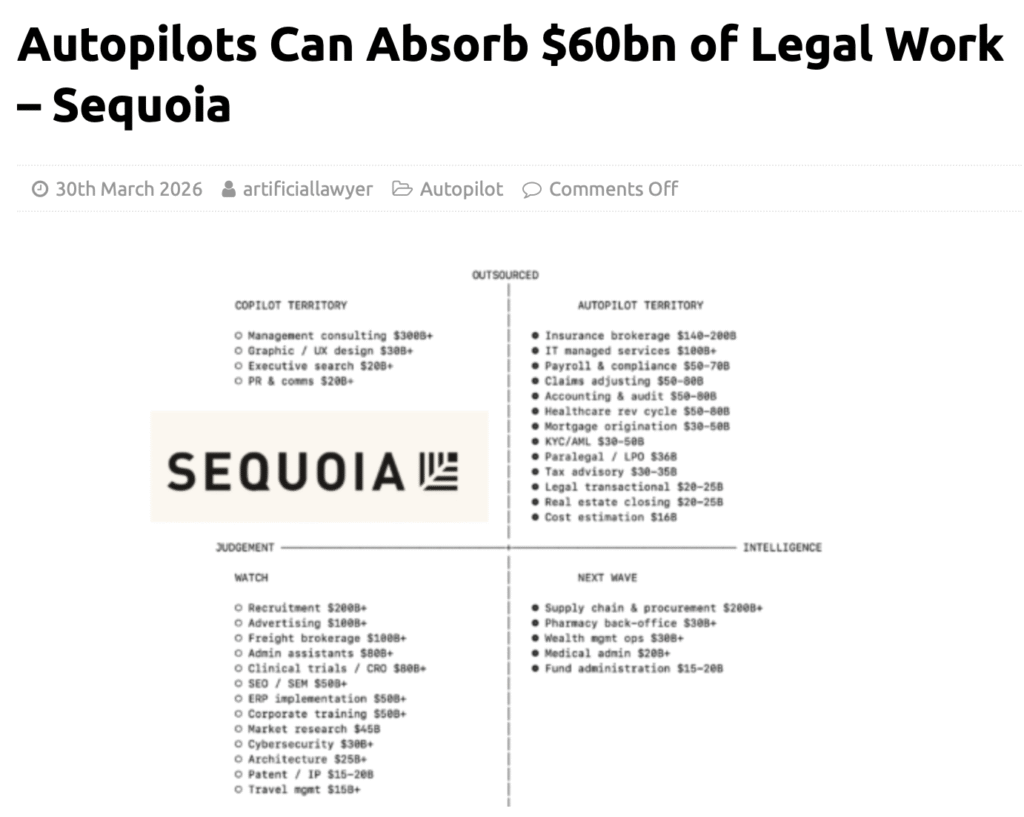
That intelligence section – which is the bulk of any law firm, and in larger inhouse teams is a major part as well – is where the agentic ‘company world model’ or in this case a ‘law firm world model’ can really be effective.
As Pereyra states: ‘We can see clear and enduring shifts in how AI will affect legal both as consumers of agents and as essential stakeholders in how agents are implemented across organizations. Like in other industries, legal agents will begin to challenge structural conventions in law firms.
‘Firms are deeply hierarchical, using reporting chains between associates and partners to channel the limited resource of legal expertise across vastly complex matters. The more junior parts of this hierarchy are focused on throughput — organizing vast troves of data or executing largely rote tasks.
‘As these tasks become increasingly delegated to agents, intelligence replaces hierarchy. Every lawyer is now prized for their judgment, not their output; requiring firms to rethink staffing, apprenticeship, pricing, practice-area structure, and the way they work with clients.’
In short, it all goes back to the central idea of legal AI – one that has been this site’s and many others’ dream since the start of this a decade ago, namely: that AI becomes the central means of legal production.
The lawyers who continue to add value to this process are those who bring very human and expert skills: judgment, client engagement, vision, imagination that goes beyond anything stated literally in a matter, instinct, and even intuition. Ironically, the value of law firms then goes back to how it was in the old days: the ability to provide trusted, expert advisers – not legions of associate labour. The industrialised pyramid that Big Law has built out using human labour since the 1980s, gets turned into something where agents are driving the legal production.
What Does This Look Like?
So, what would this look like? Pereyra puts it this way: ‘We expect these trends to emerge at the matter level. Each matter and its associated documents, messages, research, workflows, and other data can be analogized to a standalone world model within which teams of AI agents can operate to transform legal practice.
‘This transformation does not displace lawyers, but it does change how matters are coordinated, how judgment is applied, and where leverage can be found for both law firms and in-house teams. More throughput will fundamentally mean more judgment calls, and a deeper need for not only high-skill, but high-trust lawyers.’
On the displacement point, we cannot know for sure yet. As AL and others have explored we then run into: how do you train new lawyers to provide judgment level work? If you are more productive how do you ‘feed the engine’? And can law firms adapt to this new world, or will the NewMods beat them to this outcome? Plus, it does seem that law firm staffing will change – it will have to. But, if total legal demand keeps increasing globally, then the ‘end of lawyers’ remains far off.
Pereyra adds: ‘For inhouse teams, the proliferation of agents requires them to not only navigate transformation in their direct work, but to serve as stewards for effective AI implementation across their organizations.’
I.e. inhouse teams will not just use agents internally within their team, but will now have to police the actions of agents across the whole company. And some legal tech startups have begun to consider this already, take Norm, for example, see AL article here.
Conclusion
What Harvey’s Pereyra is describing is the outcome many in the field of legal AI have been hoping for: the real transformation of the sector. And he certainly believes that agents are the key to unlock the gateway to this change.
He concludes: ‘Legal will be one of the industries most transformed by agents, but it will also be one of the most important in determining whether this technology goes well for society.
‘As throughput ceases to be a meaningful constraint, the central questions stop being what should people do, but how do we organize around intelligence and govern results. These questions are legal as much as technical.
‘As early and essential adopters, law firms and in-house teams are going to define what trustworthy adoption looks like: where accountability sits, what risks are acceptable, what governance is required, and what it means to rely on an autonomous system inside a real institution.’
—
Exciting times. Thanks to Gabe for this insightful and inspiring article. You can read the whole article, which includes some great anecdotes, on X here.
—
A Legal Tech Conference For All of Europe
Legal Innovators Europe – Paris – June 24 and 25.

There will be more news about the conference and key speakers as we get closer to June.
Look forward to seeing you there!
Richard Tromans, Founder, Artificial Lawyer and Legal Innovators conference Chair.
Note: the conferences are organised by Cosmonauts – please contact them with any queries.
If you would like to be a speaker at Legal Innovators Europe, especially if you are at a law firm or inhouse legal team in Europe – whether based in France, Belgium, Spain or Germany, or beyond…..then please contact Phoebe at Cosmonauts: phoebe@cosmonauts.biz
Note: if you are a legal tech company, please contact Robins: robins@cosmonauts.biz or Anjana anjana@cosmonauts.biz
–
And if you’re in the US and looking for the next major event to join after Legal Week, then see you in California this June!
Legal Innovators California, the landmark West Coast legal tech event, will take place on June 10 and 11, in the heart of the Bay Area, the home to many of the world’s leading AI businesses – and plenty of legal tech pioneers as well! More information and tickets here.

Discover more from Artificial Lawyer
Subscribe to get the latest posts sent to your email.