
NewMod, AI-first law firm, Crosby, has just raised $60m with backing that includes Bain Capital and Sequoia, which is impressive – but what stood out this week was their founders’ comments targeting Big Law’s apparent lack of R&D spend. Despite the fact that ‘America’s top 100 law firms made a combined $69 billion in profit last year, greater than Google’s R&D budget…every cent was paid out to the firms’ partners as compensation’, they pointed out.
This debate about law firms not spending on R&D did the rounds many years ago, but today it’s perhaps more relevant than ever before. So, first, is it true? Do large commercial law firms avoid R&D despite their financial resources? Is this – as Crosby is suggesting – a failure to invest in improvement?
It’s a challenging question, but from many lawyers’ perspective it doesn’t land. Why? Because from a law firm’s view they are indeed investing every day in R&D – just not always in changing the delivery of their services. Their investment is in areas such as training their new talent, in developing their knowledge bank, in indexing and retaining their own product innovations, i.e. their proprietary work, and in building relationships with new clients and more.
In fact, if you want to get philosophical, then one can say that every time a law firm takes on a complex matter with novel legal problems to solve, then it is doing R&D. Although, it’s getting paid by the client for that ‘research and development’ of a solution to their need.
So, do law firms invest in R&D? Well, yes, they do. Just not like how tech companies think about the subject.
But, even so, do they invest in tech? Do they explore and ‘research’ how to use that tech? Clearly, yes, but the answer here is more nuanced.
While a law firm will pull out all the stops to come up with a ‘never seen before’ solution to a client’s gnarly legal issue, they likely won’t – usually – pull out all the stops to disrupt themselves and find totally new ways of working.
Law firms are not like car companies, always seeking to find a new way to deliver the product faster and cheaper. The billable hour + pyramid of legal labour works very well for them – for now – and so the core delivery model won’t really change….yet. Expecting the larger law firms to divert partner profits into doing what NewMods are doing, i.e. creating an entirely new AI-first way of working, is unlikely – even if they may build small business units – rather like they did with captive ALSPs in the 2010s – but not for the whole firm. Not yet……(but that could change in the medium-term).
Would it be great for Big Law to actively seek to reinvent itself? Yes, and AL believes much of the AmLaw 200 and UK 100 will have to do that eventually. The question is: how long before that happens?
For now, however, Crosby looks like a faint object on the distant horizon to Big Law. Most firms won’t even bother to worry about it, or the comments about not investing in R&D.
Of course, they might wake up one morning to the end game of the innovator’s dilemma and find some of their key clients have deserted them because the NewMods have moved far beyond simple contracts and right up the value chain by leveraging ever-improving AI to its max.
Any road, congrats to Crosby on the raise.
—
Note: because of Easter, Artificial Lawyer will be back on Tuesday. And now some more news.

—
Legora has made public the fact that they’ve hit $100m ARR (see chart below). They’ve also opened an office in Munich.

—
Solve Intelligence has acquired Palito.ai, a Munich-based startup specialising in AI-powered patent litigation and prior art analysis.
The acquisition ‘deepens Solve’s investment in patent litigation, adding Palito’s strengths in validity analysis, case law research, and European patent workflows to Solve’s existing Charts product’.
The result is a single platform where IP professionals can handle invalidity claim charts, SEP claim charts, freedom-to-operate and clearance analyses, infringement mappings, claim construction analyses, portfolio analyses, and more, they said.
—
Litify has launched its Agentic Case Expert (ACE). It powers capabilities across the platform, including Ask, Draft, Summarize, the Prompt Library, and both packaged and custom Litify AI agents, enabling more intelligent, autonomous workflows, such as:
- ‘Intake Agent: Identifies high-value cases, recommends conversion, and sends retainers via e-signature to accelerate onboarding
- Treatment Plan Agent: Automates client reminders and follow-ups based on treatment status to maximize case value
- Policy Agent: Flags untapped coverage by comparing policy limits and benefits across case documents, catching opportunities humans might miss
- Damages Assistant: Identifies missing records or bills and automatically generates requests, saving hours of manual work. It also flags surgery recommendations or new diagnoses to help your team increase case value.
- Instant Demands: Detects when damages are trending toward policy limits and generates a demand letter, saving time while keeping cases moving forward
- Litigation Agent: Drafts interrogatory responses and provides consolidated case updates to streamline litigation preparation. It also analyzes deposition files and transcripts to recommend additional people to depose or missing documents to request, reducing time on desk.’
More here.
–
Thomson Reuters and Hotshot have announced a partnership to combine AI with practical, skills-based legal training content – and will put that directly in the hands of law students before they ever set foot in a law firm.
Hotshot and CoCounsel Legal will provide law students with ‘hands-on experience to the very latest in AI technology, making them more appealing to employers and preparing them for practice right after graduation’ they said.
By combining these resources, students gain exposure to cutting-edge AI tools, practical skills and essential methods to succeed from the start of their legal careers. With Hotshot videos, students learn substantive concepts, then use CoCounsel Legal to apply this knowledge – creating well-structured, research-driven work product that meets future workplace standards, they added.
—
How Do AI Native Law Firms Work?
And now a great video all about how General Legal works, and more broadly how NewMods, legal AI-first firms are operating. Thanks to JP Mohler for the incisive interview.
–
And of course…..A Legal Tech Conference For All of Europe
Legal Innovators Europe – Paris – June 24 and 25.

There will be more news about the conference and key speakers as we get closer to June.
Look forward to seeing you there!
Richard Tromans, Founder, Artificial Lawyer and Legal Innovators conference Chair.
Note: the conferences are organised by Cosmonauts – please contact them with any queries.
If you would like to be a speaker at Legal Innovators Europe, especially if you are at a law firm or inhouse legal team in Europe – whether based in France, Belgium, Spain or Germany, or beyond…..then please contact Phoebe at Cosmonauts: phoebe@cosmonauts.biz
Note: if you are a legal tech company, please contact Robins: robins@cosmonauts.biz or Anjana anjana@cosmonauts.biz
–
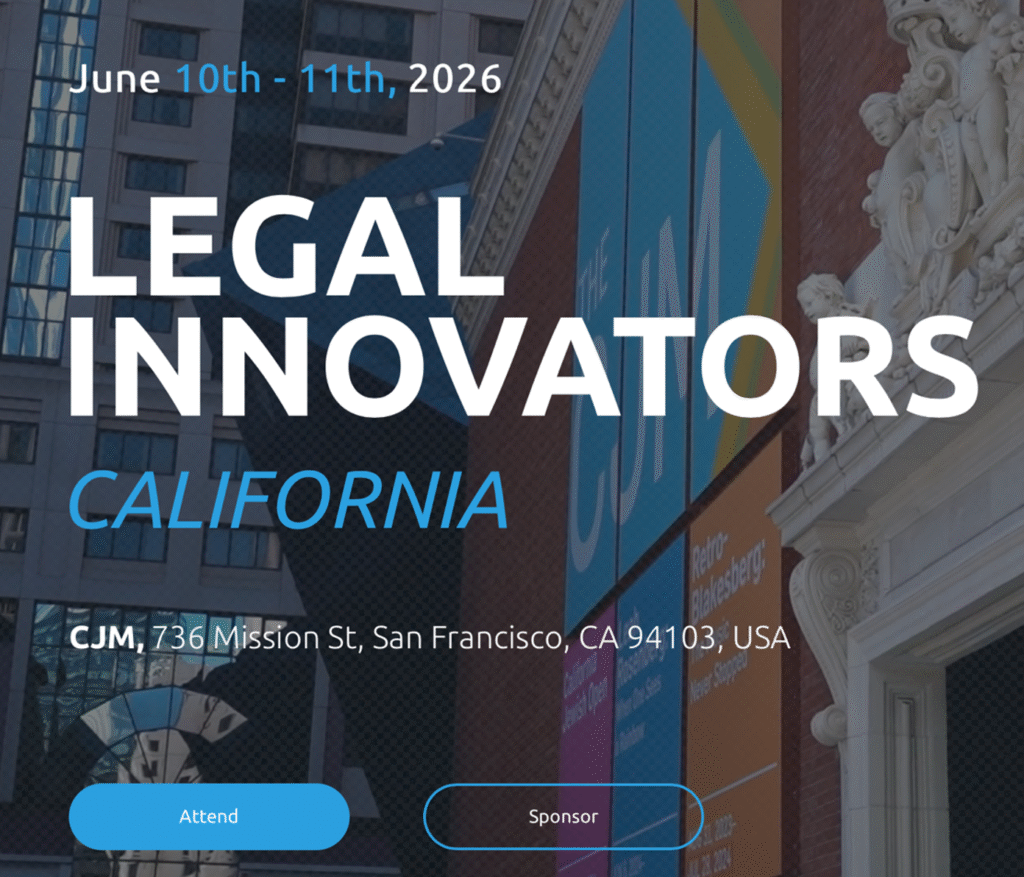
And if you’re in the US and looking for the next major event to join after Legal Week, then see you in California this June!
Legal Innovators California, the landmark West Coast legal tech event, will take place on June 10 and 11, in the heart of the Bay Area, the home to many of the world’s leading AI businesses – and plenty of legal tech pioneers as well! More information and tickets here.
—
That’s all folks, have a great Easter!
As mentioned, AL is back on Tuesday next week.
Richard Tromans, Founder, Artificial Lawyer and Chair of the Legal Innovators conferences.
Discover more from Artificial Lawyer
Subscribe to get the latest posts sent to your email.